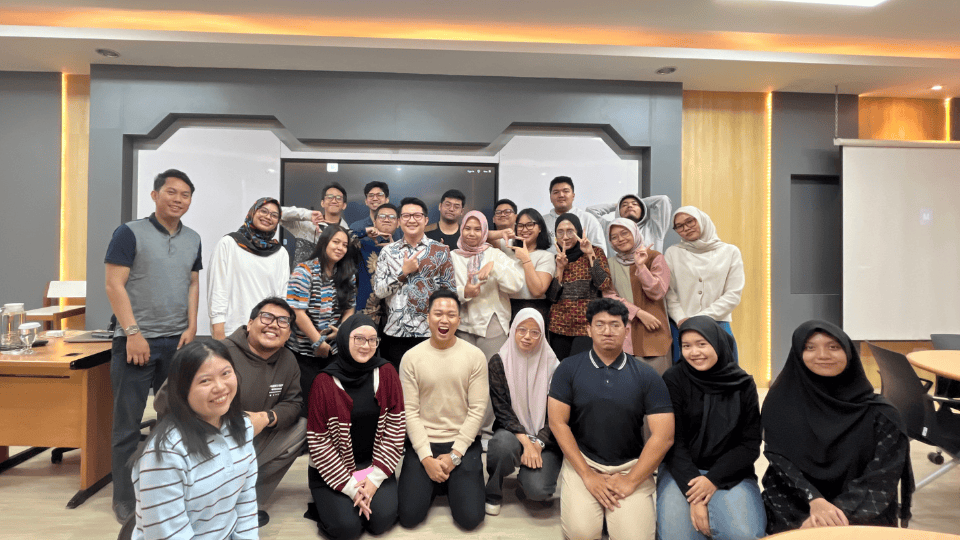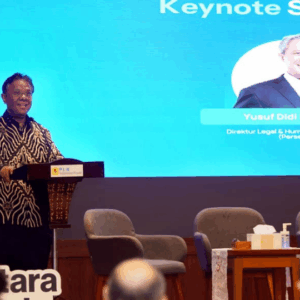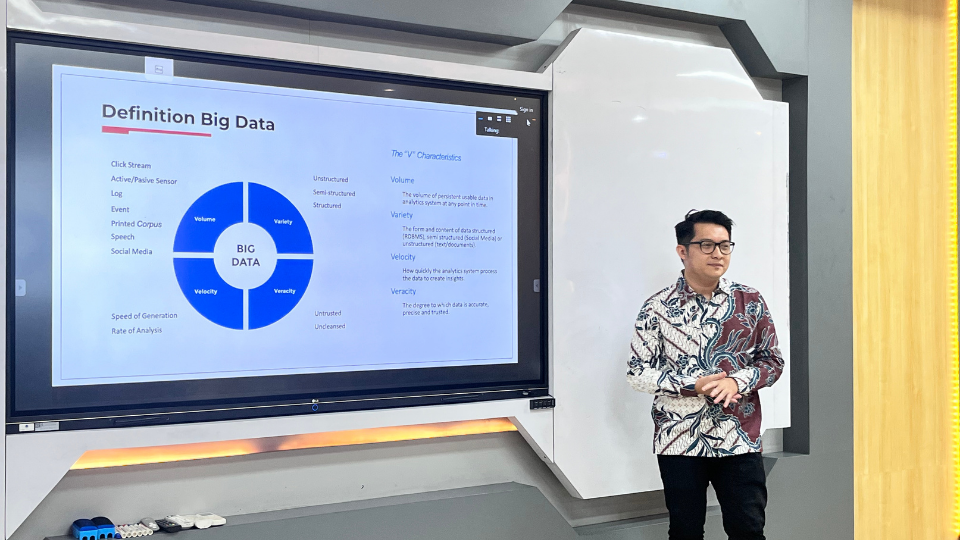
For modern organizations, the ability to analyze big data to discover and interpret meaningful patterns is fundamental to making important and accurate decisions. This understanding was gained by SBM ITB MBA students in the Young Professional class during the Digital Business Experience course, which included a guest lecture on Machine Learning at the ITB MBA Bandung Campus on Friday (November 28th). The event featured William Anandes Duti, a practitioner and Practice Assistant – International Certification Big Data Analyst, who discussed the application of big data and machine learning in the modern business environment.
In his presentation, William outlined the concept of big data with its 5V characteristics: volume, variety, velocity, veracity, and value as aspects of data quality. He explained that big data emerges from various sources such as reviews, digital conversations, networks, CCTV, and location tagging, and that the main opportunity lies in analytics.
Through analytics, organizations can discover and interpret meaningful patterns in data, which then evolve into the realm of data science and become the basis for various important decisions. He emphasized the role of social computing as a crucial benefit of analytics, generating various insights such as market segmentation, fraud detection, personalized advertising, and consumer behavior analysis.
William also highlighted that 80% of the world’s data is unstructured, requiring extensive processing, including social network analysis and text mining. He explained the four levels of analytics: descriptive, diagnostic, predictive, and prescriptive, which help organizations understand events, analyze causes, predict possibilities, and determine optimal actions. He added that algorithms and big data now shape social behavior through media and the competition for public attention.
In the closing section, William explained the role of machine learning in AI, including its relationship to deep learning. He also introduced three main types of learning: supervised learning with labeled data, unsupervised learning with unlabeled data, and reinforcement learning, which learns through actions and rewards. He explained that AI relies on large amounts of data for machines to learn effectively.
After the presentation, the activity continued with a hands-on session using Orange, an open-source toolkit for data visualization, machine learning, and data mining. Orange provides a visual programming front-end that facilitates data exploration, qualitative analysis, and interactive data visualization. Through this session, students have the opportunity to build data analysis flows and understand how algorithms work in a more practical way.