Founders often make a common mistake: they fall in love with their product before understanding their customers. They build it first and then ask if anyone needs it.
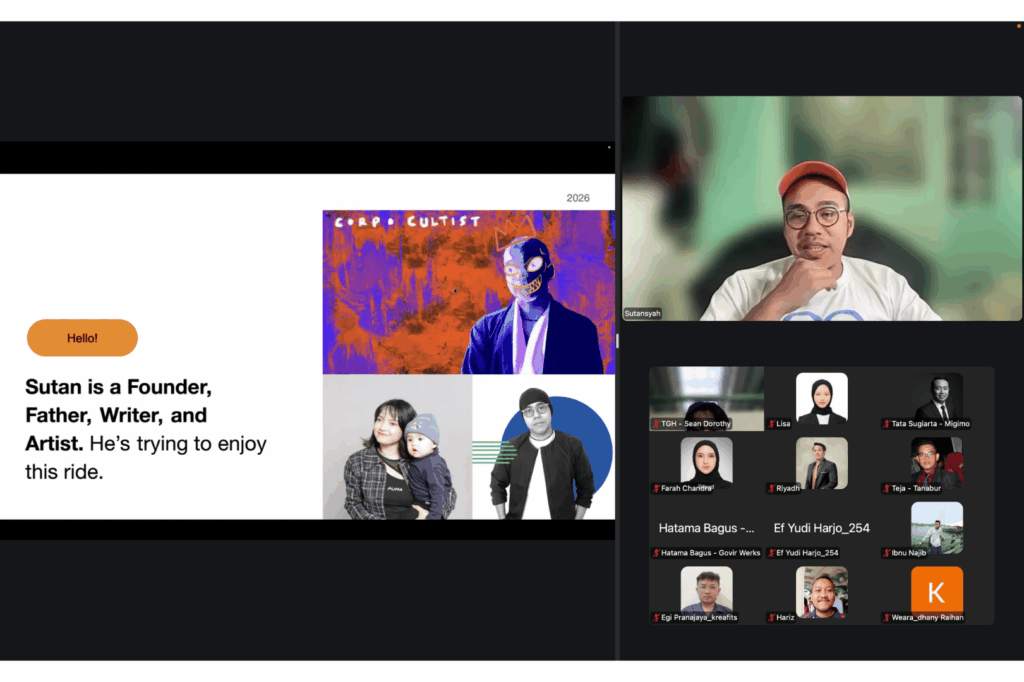
Sutansyah Marahakim, Creative Director & Partner at PT Kolaborasi Kapital Indonesia, has witnessed this pattern for over a decade. Therefore, when invited to speak at the Greaterhub XX seminar organized by the School of Business and Management, Institut Teknologi Bandung (SBM ITB) (March 13th), he provided founders with new perspective. Kolaborasi Kapital is a venture studio founded in 2013 that has mentored numerous businesses across various industries, including agricultural platforms, youth media, legal technology, and music.
According to Sutan, founders must understand consumer needs. This requires market validation. Business validation is fundamental: how a founder learns to balance what the market needs with what they believe should be built. That balance, according to Sutan, is the essence of true product-market fit.
Sutan added that the first killer of a business isn’t competition, funding, or a bad team. It’s the lack of market need. When a product doesn’t align with what buyers are looking for, no sales strategy is strong enough to fill the gap. Founders will push hard, while the market moves in the other direction.
“The greatest sales strategy is a good product. If your product aligns with market needs, the effort won’t be as heavy as pushing the wrong product into the wrong market,” Sutan said.
Sutan introduced the Design Sprint, a method developed by Google Ventures and now utilized by thousands of teams worldwide, ranging from small startups to established companies like Slack, Airbnb, and Spotify. The purpose of this method is not to create a perfect product but to minimize the risk of failure from the outset by placing the user at the center of every decision.
What distinguishes it from the usual approach is one often-overlooked principle: we don’t know what we don’t know. Before diving into the market and interviewing users, founders must first develop an honest hypothesis about who their users are and what they’re really looking for.
Sutan then introduced a framework that he believes founders often overlook: four market strategies that determine the direction of business validation. First, follow existing market conditions and adapt products to proven demand. Victory lies in distribution, efficiency, and accessibility.
Second, adapt to changing market trends to develop relevant products (respond). We can excel if we are fast and experimental.
Third, change market behavior towards existing categories (shape). Gojek, Traveloka, Apple, and Spotify not only entered existing markets but also changed how people interact with them.
And fourth, create demand for something previously unconsidered as a need (create). Airbnb, Tesla, and OpenAI discovered hidden problems that people tolerated but never tried to solve.
Sutan concluded by explaining that achieving product-market fit requires both validation and vision. These two elements must work together. Founders who focus solely on vision, without seeking validation, may create something beautiful but ultimately unpopular. Conversely, founders who pursue validation without a clear vision tend to follow trends rather than creating something truly innovative. Effective leaders not only pay attention to what the market is saying but also perceive what the market has yet to articulate.