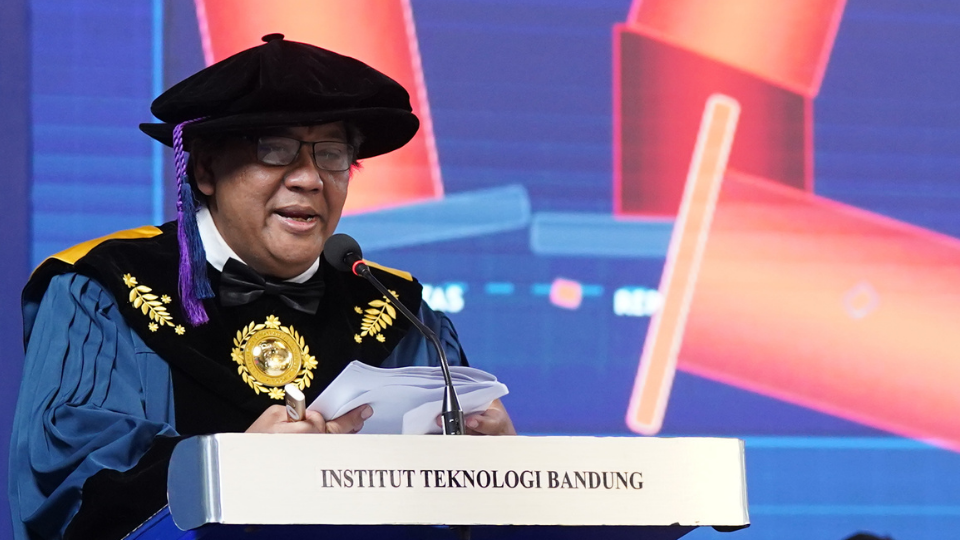
Professor Deddy Priatmodjo Koesrindartoto, Professor of Business and Management, Institut Teknologi Bandung (SBM ITB) and member of the Business and Financial Risk Research Group, invites us to reexamine the role of economists amid the increasingly complex dynamics of the global economy.
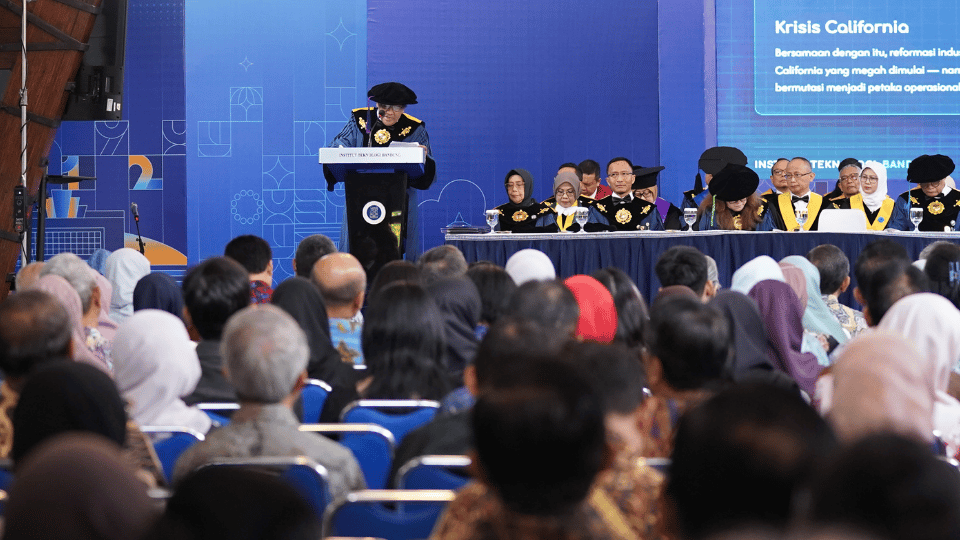
“Today I want to raise a question that has long troubled my perspective on economics. Is the economist’s job only to explain the world, or should they also design a world that won’t collapse easily?” he said in his Professorial Oration held at the West Hall of ITB, Bandung, on Saturday (July 11).
In his scientific oration, titled “Economist as an Engineer: For a Resilient and Just Economy,” he emphasized that the role of economists should not be limited to mere market observers.
“Should we be content to be market observers, or should we become engineers who design policy systems and the markets themselves?” he continued.
Prof. Deddy explained that the idea arose from his personal experience while pursuing his doctoral studies in the United States during the 1997–1998 Indonesian monetary crisis. In his classroom abroad, he witnessed how the Indonesian economic system experienced a major shock that was difficult to explain through conventional economic approaches alone.
According to him, this experience shaped his belief that the collapse of an economic system cannot always be understood or resolved solely through static monetary instruments. During the same period, he also studied the California electricity industry deregulation crisis, which demonstrated that inappropriate market design can trigger widespread system failure. This experience then became the starting point for his interest in market microstructure and a more adaptive approach to economics.
In his speech, Prof. Deddy introduced a paradigm shift in the way we view economic systems. He compared the top-down neoclassical economic model with the bottom-up Agent-Based Computational Economics (A.C.E.) approach.
According to him, the neoclassical model assumes homogeneous agents, perfect rationality, symmetric information, and equilibrium that can be achieved through mathematical optimization. In contrast, the A.C.E. approach views the economic system as a collection of thousands of heterogeneous agents, possessing imperfect information, learning adaptively, and generating organically emerging dynamics (emergence) that do not always end in equilibrium.
This paradigm shift, according to Prof. Deddy, enables space for economists not only to explain economic phenomena but also to design systems that are more resilient to uncertainty, more adaptive to change, and fairer for all economic actors.
In closing, Prof. Deddy emphasized that an economist has a responsibility similar to that of an engineer: ensuring that the systems they build can protect society from systemic failure.
“If an engineer’s job is to ensure that bridges don’t collapse, an economist’s job is to ensure that policy and market systems don’t collapse those we serve,” concluded Prof. Deddy.
Prof. Deddy is an academic with a keen interest in financial economics, particularly in developing more adaptive and resilient economic systems. Throughout his academic career, he has led 12 research projects and participated as a member in five others.
In addition to producing 36 Scopus-indexed publications (Q1–Q4), eight SINTA publications, and an h-index of 8, Prof. Deddy also received the Highly Commended Paper award from the Emerald Literati Network Awards in 2016 and the Ganesha Wira Adiutama Award in 2025. To date, he has mentored 83 Bachelor of Management graduates, 31 Master of Science in Management graduates, 37 Master of Business Administration graduates, and eight Doctor of Science in Management graduates.
Through his scientific oration, Prof. Deddy encouraged academics, policymakers, and practitioners to view economics not only as a science that explains market behavior, but also as a discipline capable of designing a more resilient, adaptive, and equitable economic system for society.
Written by Student Reporter (Lavena Laduri, MBA YP 2024)