
Advancing Sustainable Business. Creating Societal Impact.
The Institute for Sustainable Business, also known as Lembaga Bisnis Berkelanjutan (LBB), is a strategic unit of the School of Business and Management, Institut Teknologi Bandung (SBM ITB). The Institute brings together academic knowledge, entrepreneurial thinking, and collaborative action to address complex sustainability challenges faced by businesses and society.
LBB works at the intersection of business, education, and societal development. We believe that sustainable transformation requires more than good ideas. It requires relevant knowledge, capable people, strong institutions, collaborative ecosystems, and solutions that can be implemented in real-world settings.
Through research, education, community engagement, and multi-stakeholder collaboration, LBB supports the development of businesses that are economically viable, socially responsible, and environmentally sustainable.
About the Institute
Businesses today are expected not only to generate economic value but also to respond responsibly to social and environmental challenges. Climate change, inequality, technological disruption, and changing employment patterns require organizations to rethink how they create value.
Higher education institutions face similar expectations. Universities and business schools must go beyond producing excellent graduates and responding to the immediate needs of today’s businesses. They are increasingly expected to demonstrate how education, research, innovation, and partnerships contribute to meaningful societal change.
At the same time, communities, MSMEs, entrepreneurs, and public institutions need stronger capabilities and more supportive ecosystems to participate in sustainable economic development.
LBB was established to address these challenges by connecting SBM ITB’s academic capabilities with the needs of businesses and society. It provides a collaborative platform for academics, students, businesses, government institutions, communities, alumni, and development partners to transform knowledge into practical solutions and measurable impact.
Our work is guided by the principle that business sustainability and societal well-being are interconnected and should be developed as part of a shared agenda.
Our Purpose
LBB aims to strengthen SBM ITB’s contribution to sustainable economic and societal development. We translate knowledge into action by developing applicable research, strengthening entrepreneurial capabilities, supporting community-based businesses, and facilitating collaboration among diverse stakeholders.
Our Strategic Pillars
LBB develops its work through two interconnected strategic pillars: Entrepreneurial Business and Societal Impact.
Entrepreneurial Business
As an institution of world-class excellence in higher education, SBM ITB is expected not only to deliver management education but also to build and share distinctive expertise that can guide businesses and society. SBM ITB positions Entrepreneurial Business as its thought leadership.
Entrepreneurial Business is not limited to establishing new ventures. It refers to the ability of individuals and organizations to identify opportunities, mobilize resources, build collaborative ecosystems, respond to uncertainty, and create responsible and sustainable value. This orientation is relevant to start-ups, MSMEs, corporations, public institutions, social enterprises, and community-based organizations.
Research serves as the main foundation for strengthening this thought leadership. Through evidence-based research, SBM ITB develops concepts, frameworks, and practical insights in areas such as:
- Entrepreneurship and intrapreneurship
- Sustainable business and responsible innovation
- Business ecosystems and digital platforms
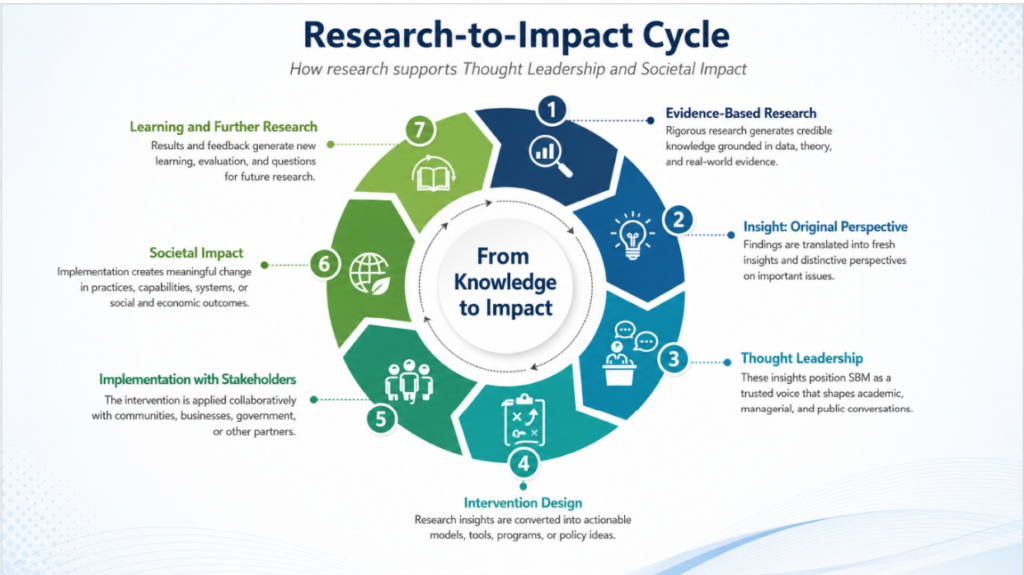
Thought leadership does not end with research publications. The knowledge generated also enriches academic development at SBM ITB, informs curriculum and learning experiences, and strengthens community engagement and empowerment programs. In addition, these research-based insights are systematically synthesized into policy-oriented outputs (white papers and policy briefs) intended to inform decision-making in both the public and private sectors. Through this mechanism, SBM ITB positions itself not only as a knowledge producer, but also as a strategic partner in shaping policy discourse and institutional reform.
Through this connection, research generates knowledge, knowledge enriches education, and academic expertise is translated into interventions that create meaningful impact for business, government, and society. Experiences from these interventions then provide new insights for future research and knowledge development.
Societal Impact
Societal Impact represents our commitment to ensuring that education, research, innovation, and academic expertise contribute to meaningful, measurable, and sustainable transformation in society.
For LBB, societal impact is not defined merely by the number of programs conducted, participants involved, or communities reached. It is demonstrated by the changes generated through those activities, such as stronger livelihoods, more capable and resilient enterprises, better employment opportunities, stronger local institutions, more inclusive business ecosystems, and improved collaboration among stakeholders.
Rather than focusing only on the direct benefits delivered to specific groups through individual projects, societal impact considers how academic contributions can influence broader systems. This includes changes in organizational practices, institutional arrangements, stakeholder relationships, business ecosystems, public policies, and the ways in which societal challenges are understood and addressed.
This pillar, therefore, connects education, research, innovation, community engagement, and multi-stakeholder partnerships. Academic knowledge is translated into practical interventions, institutional strengthening, business development, and policy recommendations. Evidence and learning from society are then brought back into research and education, creating a continuous cycle of knowledge development and impact.
Particular attention is given to inclusive economic development, sustainable livelihoods, community empowerment, entrepreneurship, decent work, and economic growth, in alignment with the United Nations Sustainable Development Goals, especially SDG 8: Decent Work and Economic Growth.
Through this approach, LBB seeks not only to create immediate benefits but also to strengthen the capabilities, institutions, and ecosystems required to sustain and expand positive change over time.
Our Impact Goals
LBB seeks to contribute to long-term and measurable improvements in economic participation, entrepreneurial resilience, and employment creation.
Toward 2031, our societal impact goals include:
- Supporting the continued operation of at least 70% of incubated micro-businesses
- Contributing to economic growth among at least 50% of assisted MSMEs
- Contributing to the creation of 500 new employment opportunities
These goals provide a long-term direction for our programs. Progress will be assessed not only through activity-based indicators but also through evidence of changes experienced by businesses, communities, and other stakeholders.
Societal Impact Loci
Where Knowledge Meets Society
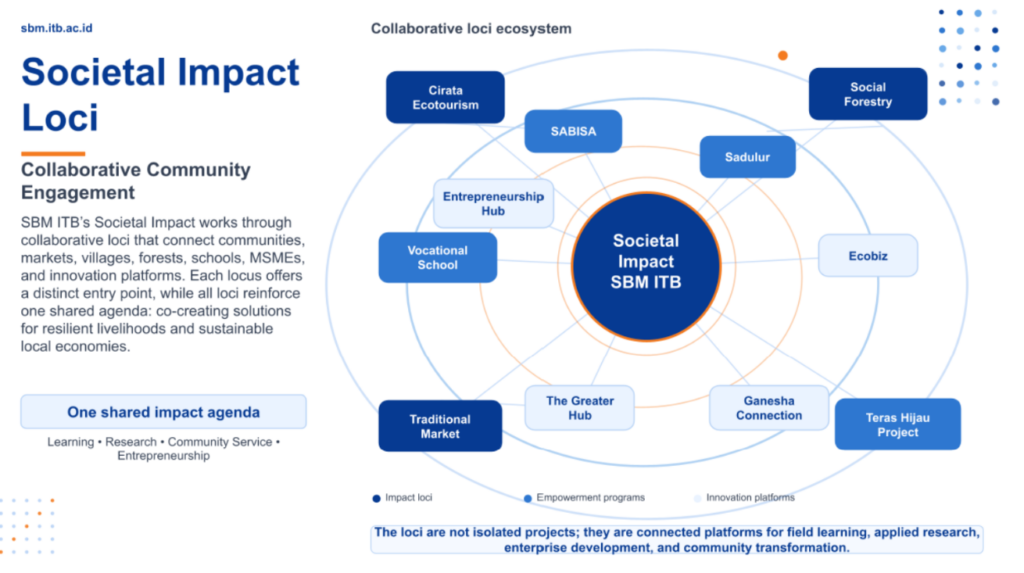
The Societal Impact Loci are the environments in which SBM ITB connects education, research, entrepreneurship, and community engagement with real societal challenges.
A societal impact locus is not merely a location where a short-term activity is conducted. It is a collaborative entry point through which SBM ITB works with communities, businesses, schools, public institutions, and other partners to understand local challenges, develop practical solutions, strengthen capabilities, and create measurable improvements over time.
The loci provide opportunities for faculty members, students, researchers, entrepreneurs, and partners to work directly with society. They function as living environments for field-based learning, applied research, enterprise development, institutional strengthening, and community transformation.
Together, the loci support LBB’s shared impact agenda:
Empowering Communities through Entrepreneurial Leadership and Sustainable Innovation
Although each locus addresses a different context, they are connected by a common objective: strengthening sustainable livelihoods, developing responsible enterprises, and supporting inclusive local economic growth.
A Connected Societal Impact Ecosystem
LBB’s Societal Impact portfolio consists of field-based impact loci, community empowerment programs, and innovation and entrepreneurship platforms.
These components should not be viewed as isolated projects. Field-based loci provide real societal contexts and challenges. Community empowerment programs strengthen the capabilities of individuals and institutions. Innovation platforms connect ideas, knowledge, technology, mentors, markets, and other resources needed to develop sustainable solutions.
By connecting these components, LBB creates an ecosystem in which insights from society can inform education and research, while knowledge and innovation from the university can contribute to societal development.
Societal Impact Loci
Societal Impact Loci (singular: locus) are sustained, real-world environments in which SBM ITB integrates education, research, innovation, and community engagement to address societal challenges. They serve as living laboratories for students and faculty members, as well as collaborative platforms for communities and other stakeholders to co-create solutions, strengthen local capabilities and institutions, and generate measurable change over time.
Cirata Ecotourism
Cirata Ecotourism focuses on developing sustainable, community-based tourism built around the Cirata area’s natural, cultural, and social assets. The locus seeks to ensure that tourism development generates meaningful benefits for local residents. Its activities may include strengthening community enterprises, improving tourism services and products, developing local entrepreneurship, building destination management capabilities, and encouraging environmentally responsible tourism practices.
Through collaboration with community groups, MSMEs, government institutions, and other partners, this locus supports a tourism model in which communities are not merely participants but active owners and leaders of local economic development. The intended impact is a more resilient local tourism ecosystem that creates livelihood opportunities while protecting the environmental and cultural resources on which tourism depends.
Traditional Market
The Traditional Market locus recognizes traditional markets, especially those in West Java, as important economic, social, and cultural institutions. They provide livelihoods for traders and MSMEs, facilitate local economic circulation, and create spaces for daily interaction among diverse community groups.
LBB’s engagement in this locus focuses on strengthening traders’ business capabilities, competitiveness, financial literacy, digital readiness, and access to wider markets. Particular attention is also given to women’s economic empowerment and the inclusion of groups that may have limited access to formal business support.
The objective is not simply to modernize traditional markets, but to help them remain economically viable, socially inclusive, and relevant amid changes in consumer behavior, technology, and retail competition.
Social Forestry
The Social Forestry locus brings together sustainable forest management, community empowerment, and local enterprise development. Communities living around forests often depend on natural resources for their livelihoods. Sustainable development in these areas, therefore, requires a balance between economic needs, community rights and participation, institutional capacity, and responsible environmental stewardship.
LBB contributes by supporting the development of sustainable forest-based enterprises, strengthening community organizations, identifying viable business opportunities, improving governance, and connecting local products and services with markets and financial resources. The intended outcome is a stronger community-based forest economy that improves livelihoods while maintaining the long-term ecological value of forest resources.
Teras Hijau Project
The Teras Hijau Project promotes community transformation through circular-economy practices and environmentally responsible entrepreneurship. The program encourages communities to see waste and underutilized resources as opportunities for innovation and economic value creation. Its activities may involve waste management, recycling, product development, green entrepreneurship, community education, and the development of locally appropriate circular business models. Teras Hijau demonstrates that environmental action can be integrated with community empowerment and the creation of sustainable livelihood opportunities.
Sadulur
Sadulur is a mentoring and empowerment program designed to strengthen the capabilities and resilience of MSMEs. The program connects business owners with knowledge, mentors, networks, and other forms of support relevant to their development. Areas of assistance may include business planning, financial management, marketing, digitalization, product development, operational improvement, and access to markets. Through continuous engagement, Sadulur seeks to help MSMEs move beyond short-term survival and develop stronger foundations for sustainable growth.
Sakolah Bisnis Desa (Sabisa)
Sabisa serves as a village business school that strengthens the managerial and entrepreneurial capabilities of Badan Usaha Milik Desa (BUMDes/village-owned enterprises) and other local economic institutions. The program supports village actors in identifying local assets, developing viable business models, managing organizations professionally, building partnerships, and creating businesses that respond to community needs. Sabisa positions villages not merely as beneficiaries of development programs, but as active economic actors capable of managing resources and creating sustainable value for their communities.
Vocational School
The Vocational School initiative connects vocational education with entrepreneurship, industry needs, and future employment opportunities. It supports vocational schools and students in West Java in strengthening practical skills, entrepreneurial competencies, industry readiness, and understanding of changing labor market demands. Engagement may involve applied learning, mentoring, business projects, industry collaboration, and exposure to real organizational challenges. The initiative seeks to improve the transition from education to decent work while encouraging students to become capable employees, entrepreneurs, and contributors to their local economies.
The Greater Hub
The Greater Hub is a business incubator for incubating start-ups and supporting the development of early-stage ventures. It provides entrepreneurs with access to mentoring, business knowledge, networks, market opportunities, and other resources needed to transform ideas into viable enterprises. The platform also creates opportunities for collaboration among start-ups, academics, investors, industries, government institutions, and entrepreneurial communities. Within the Societal Impact ecosystem, the Greater Hub helps ensure that entrepreneurial innovation can be directed toward sustainable business development and relevant societal needs.
Ganesha Connection
Ganesha Connection serves as a bridge between knowledge, innovation, business opportunities, and commercialization. The platform helps connect ideas and innovations emerging from ITB as an academic environment with entrepreneurs, industries, investors, government institutions, and other potential partners. Through this connection, promising knowledge and innovation can be developed into applicable solutions, products, services, or business ventures. Its role is particularly important in helping university-based innovation move beyond the campus and create broader economic and societal value.
Ecobiz
Ecobiz supports the development of a connected digital ecosystem for MSMEs and sustainable businesses. The platform can facilitate access to business knowledge, networks, mentoring, markets, and relevant support services. By using digital technology, Ecobiz helps expand the reach of business development initiatives and enables entrepreneurs from different locations to participate in a shared learning and business ecosystem. Ecobiz strengthens the connection between digital transformation, MSME development, and sustainable economic growth.
Entrepreneurship Hub
The Entrepreneurship Hub is an ecosystem-building hub that connects diverse stakeholders across different levels, including MSMEs, start-ups, industries, universities, government institutions, financial institutions, communities, and other partners. By bringing these actors together, the Hub facilitates collaboration, knowledge exchange, resource sharing, market access, innovation, and coordinated support for entrepreneurial development. Its purpose is to build an interconnected ecosystem in which stakeholders complement one another and work collectively to strengthen entrepreneurship, business growth, and sustainable economic development.
Our Partners
Learning While Contributing
Integrating curriculum with societal impact, several courses at SBM ITB are designed or redesigned to address the needs identified within the Societal Impact Loci. Faculty members and locus teams work together to identify challenges relevant to both the communities and the courses’ learning objectives. Relevant challenges are then translated into field assignments, community projects, business analyses, applied research, or other learning activities. Students work under academic supervision and in collaboration with community members and local stakeholders.
The living-laboratory approach creates two interconnected forms of value. For students, the loci provide opportunities to test and adapt classroom knowledge in complex real-world settings. Students learn that business problems are rarely isolated from social relationships, institutional conditions, cultural contexts, environmental considerations, and the lived experiences of stakeholders.
For the loci and their community partners, student engagement contributes additional knowledge, analysis, ideas, and implementation support for ongoing empowerment programs. Student activities are designed to complement the locus agenda rather than become separate, one-time projects.
This alignment also enables continuity. The work of a single student group or course can serve as a foundation for subsequent courses, student cohorts, research projects, or partner interventions. In this way, the university’s contribution can develop progressively over time.
Societal Impact Loci as Living Laboratories
The Societal Impact Loci are developed as living laboratories where SBM ITB students can connect classroom learning with real societal challenges.
Within these living laboratories, students apply the concepts, methods, and managerial knowledge they have acquired in the classroom. At the same time, they contribute to community empowerment programs developed and implemented by each locus. This creates a reciprocal relationship: students gain meaningful, context-based learning experiences, while the loci benefit from the knowledge, ideas, research, and capabilities contributed by students and faculty members.
Students are therefore not involved merely as visitors or short-term volunteers. Their engagement is intentionally connected to academic learning objectives and the development priorities of the loci.
The Student Impact Journey
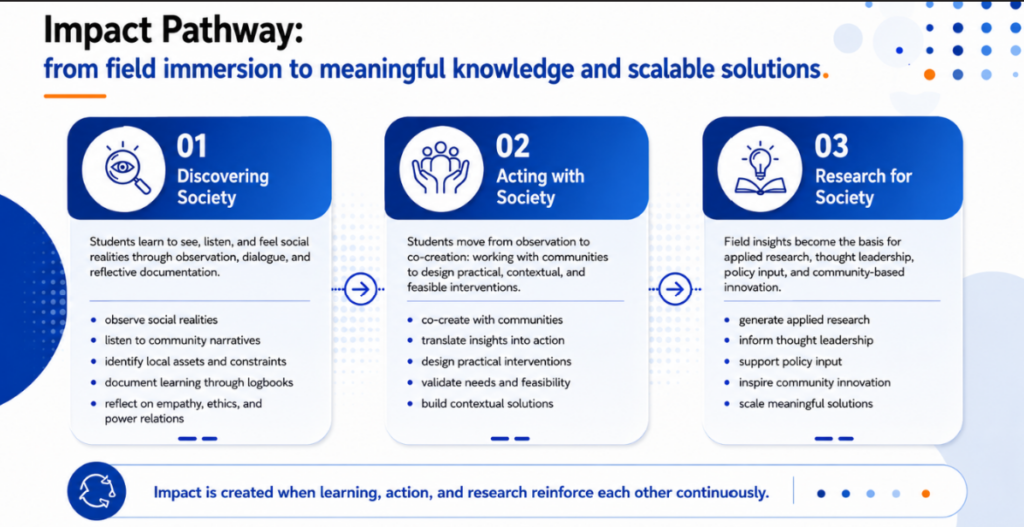
The Student Impact Journey provides a structured pathway for integrating societal impact into the student learning experience. It consists of three interconnected stages.
Stage 1: Discovering Society
In the first stage, students learn to understand society before proposing solutions. In this stage, students enter the loci to learn to understand people. This is the key to developing an impact mindset for students. The focus is on observing, listening, interacting, and learning from communities. The students explore the social, cultural, environmental, institutional, and economic conditions that shape people’s lives and livelihoods. This stage develops empathy, contextual awareness, ethical sensitivity, and respect for different forms of knowledge.
Stage 2: Acting with Society
In the second stage, students apply their knowledge by collaborating with communities and other stakeholders. Through community projects and locus-integrated courses, students help address practical challenges identified within the loci. They may support MSMEs, develop products and services, improve business processes, strengthen local institutions, or contribute to ongoing empowerment programs.
Stage 3: Research for Society
In the third stage, students use their final project research to generate evidence and knowledge that can strengthen societal impact. Challenges and insights emerging from the loci may be developed into applied research, final projects, impact evaluations, business models, policy recommendations, or community-based innovations. Research findings can help locus teams and community partners make better decisions, improve their programs, and understand the changes resulting from their interventions. The findings can also inform curriculum development, future student projects, faculty research, and the design of subsequent empowerment initiatives.
Let’s build a better future—together.
please contact our Societal Impact Program team at