Due to the Covid-19 pandemic, financial management skill is critical for many parties. It must also be constantly improved to reduce our expenses.
MBA ITB program hosted a guest lecture by Sofi Suryasnia, President Director of the BJB Bank Pension Fund, on Thursday (16/9/2021). Sofi, with accounting background, presented the material on Activity-Based Costing & Management, especially the strategy for charging costs by banks through activity tracking. For instance, lowering transaction costs for a company that works with a bank to manage its financial system.
 Because of the company’s numerous activities, ranging from payments to suppliers and distributors to pay employees’ salaries, there are times when the bank makes specific offers to provide transaction fee discounts. Customers are expected to benefit from this.
“On the other hand, it can reduce the bank’s income or opportunity gain. The loss of the company’s opportunity gain from the number of transactions should not impede banks. With this decision, it is hoped that banks will be able to look for other alternative sources of income to compensate for the loss,” said a lecturer at the ITB School of Business and Management, Padjadjaran University (Unpad), and the College of Economics (STIE) Equity.
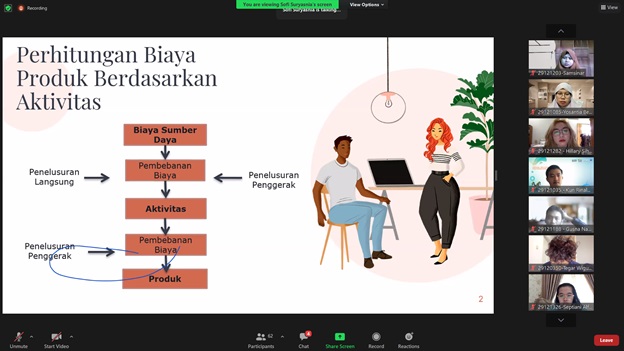 She explained that activity-based corporate and managerial costs could be applied in almost any business, including start-up businesses. However, some financial management issues arise as a result of tracking these activities. The following issues were encountered during implementation:
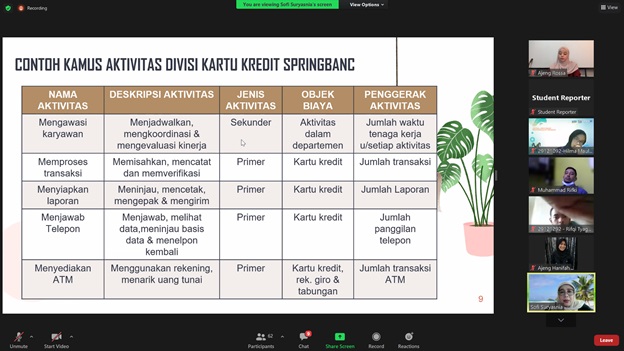
1. Data Tracking. In addition to requiring an integrated activity dictionary, some additional related information required is not yet available.
2. Willingness. A lack of top-level support and resistance to change can sometimes prevent a company from implementing activity-based financial tracking.
3. Commitment. Gaps or failures are natural in terms of expertise in using new activity information. However, if this management system produces positive results, it should not impede many parties.
With these barriers, it is hoped that the company will overcome the issue through continuous system improvements.