Many research topics are rejected by journal publishers because they are deemed not based on real-world challenges. Yet, various operational issues require research to develop applicable solutions, such as addressing supply shortages during the COVID-19 pandemic and optimizing stock placement to improve system performance and social impact.
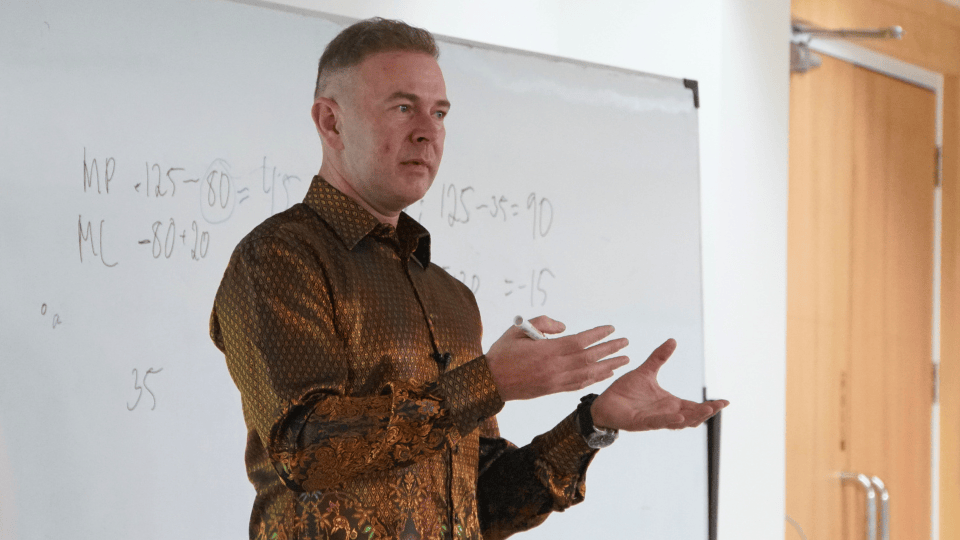
Dr. Henrik Sternberg, an Associate Professor in the Department of Supply Chain Management at Iowa State University, shared this information during an academic seminar at SBM ITB, on Thursday, January 8. In his presentation, Stenberg emphasized the importance of solving real-world operational problems through academic research.
Sternberg discussed two approaches, namely Design Science Research (DSR) and Intervention-Based Research (IBR), for conducting research for real-world needs. According to him, both research designs are widely adopted by leading journals because they can provide both practical impact and scientific contribution.
He also distinguished academic research from consulting work. Consultants, Sternberg said, generally analyze problems within an organization and offer specific solutions for that company. Scientific research, on the other hand, is expected to produce knowledge that can be transferred to various contexts. Research not only explains why problems occur but also shows how systems should be designed and how solutions can be practically implemented.
In the seminar, Sternberg explained how theories such as Principal–Agent Theory, Commons Theory, and Supply Chain Coordination Theory can be used to understand conflicts of interest, shared resource management, and collaborative decision-making in supply chains to improve coordination and operational performance.
As an example, he presented research on maintenance decision-making at KRONE Fleet, a company that operates approximately 20,000 trailers. The research focused on truck tire selection.
Although accounting for only about 2% of total costs, tire research has a significant impact on vehicle performance, safety, and operational efficiency. He explained that differences in usage conditions in urban and rural areas require different tire specifications, making maintenance decisions more complex.
Sternberg explained that KRONE’s truck fleet has been equipped with sensors that collect operational data. However, previously, this data was primarily used for tracking, not to support maintenance decisions. Through the DSR and IBR approaches, the research transformed the data into a decision-support tool for tire selection and maintenance strategies.
By applying Supply Chain Coordination Theory, the research validated the problem with industry stakeholders and aligned the interests of fleet providers and customers, enabling solutions to be implemented. As a result, the research generated annual savings of approximately IDR 133 billion, accompanied by improvements in operational performance and customer satisfaction. This research used an extended Design Science Research (eDSR) approach and is currently in the second round of review in the Journal of Operations Management.
At the conclusion of the seminar, Stenberg expressed his openness to collaboration with Indonesian partners. He believes that industry-based research can provide a space for academics and practitioners to jointly develop solutions to real-world operational challenges in various contexts.