
The integration of low-carbon technology, public policy, and green financing schemes can be implemented concretely to strengthen the competitiveness of the Indonesian steel industry amidst the dynamics of the global transition, provided the strategy is sound.
Yudo Anggoro, Director of the Center for Policy and Public Management (CPPM) at SBM ITB, stated that the strategy phase is crucial because it is here that policy direction, financial system readiness, and industry commitment converge to ensure the transition is not only ambitious but also implementable and sustainable. This means that the energy transition in the steel industry can only proceed if the environment is strong. Carbon policies, access to sustainable financing, and financing eligibility standards must ensure the industry’s transformation is systematic and competitive.
This transition strategy was the main focus of discussion in the third Live Session of the Indonesian Net Zero Steel Pathways Executive Education 2026, held online via Zoom on Thursday, February 19, 2026, organized by CPPM SBM ITB. This session is part of a five-week executive program designed to equip steel industry leaders and executives with a strategic framework for navigating the transition to Net Zero.
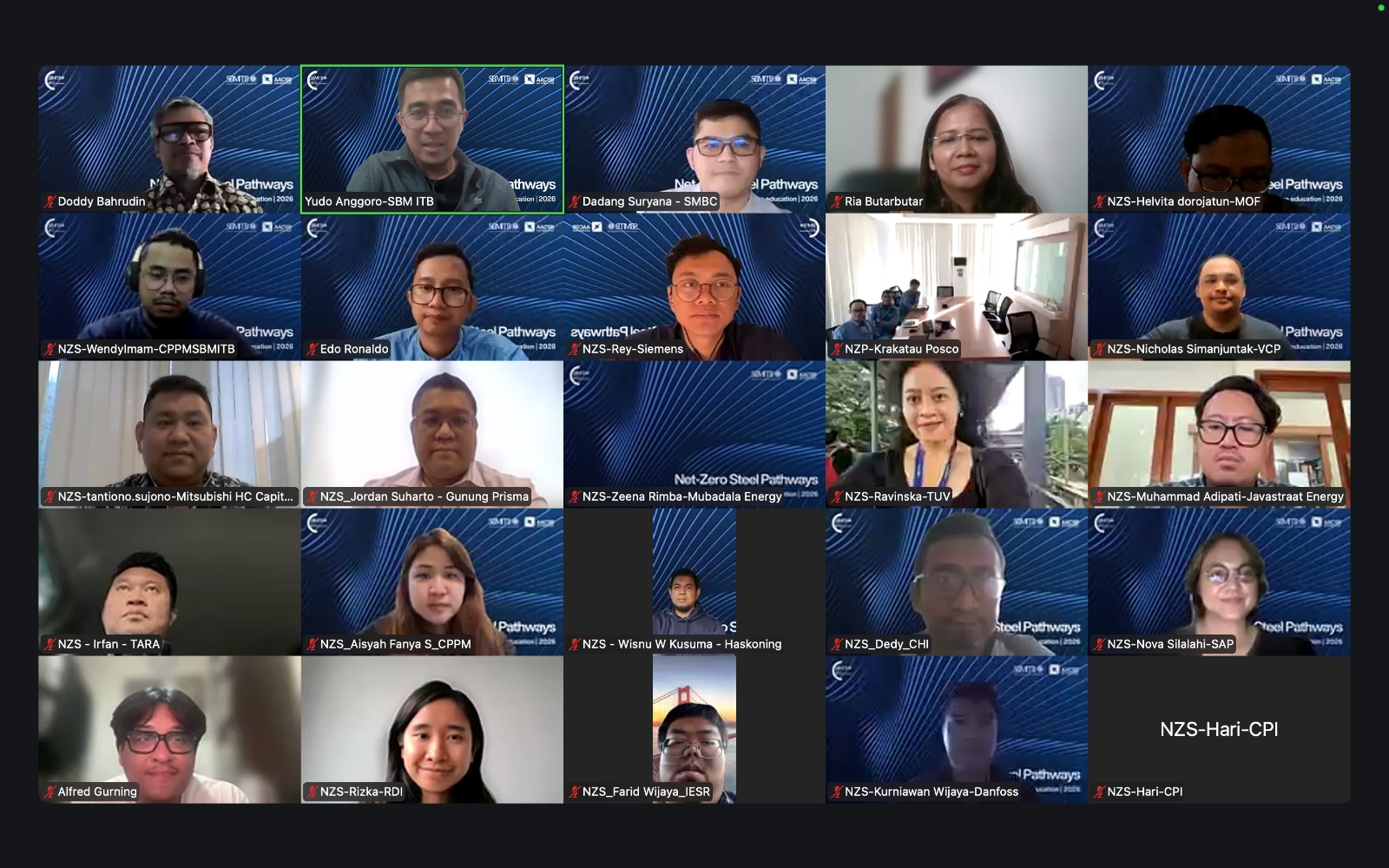
Another speaker, Baharudin, the Director of the Banking Regulation and Development Department of the Financial Services Authority (OJK), emphasized Indonesia’s commitment to sustainable finance as a key priority. Various policy frameworks have been prepared, ranging from the implementation of the Sustainable Development Goals and the long-term strategy for low-carbon development and climate resilience by 2050 to the Financial Sector Development and Strengthening Law (P2SK). Through the Sustainable Finance Roadmap Phase II (2021–2025), OJK is encouraging the formation of a comprehensive ecosystem encompassing policies, products, market infrastructure, cross-institutional coordination, human resource development, and increased literacy and awareness among industry players.
Meanwhile, Carbon Policy Expert Ria Butarbutar explained that a carbon tax is an instrument that imposes a fee on emissions that negatively impact the environment, on individuals and entities that carry out emission-producing activities. For the steel sector, specific regulations are still pending the expansion of national policies on the economic value of carbon.
From the financing side, Dadang Suryana from SMBC Indonesia outlined the importance of innovative funding schemes to support the decarbonization of heavy industry, which generally requires large investments with long payback periods. One relevant approach is blended finance. A combination of concessional funds, commercial capital, and government support to lower project risks and attract private investor participation. This type of scheme is crucial for projects in energy efficiency, electrification, renewable energy utilization, and carbon capture technology.
He also highlighted the difference between green bonds, which are based on the use of funds for specific environmentally friendly projects, and sustainability-linked bonds, which link funding costs to the achievement of sustainability targets, including emission reductions. In the context of global policies such as the Carbon Border Adjustment Mechanism, financing instruments linked to carbon performance are becoming increasingly important for maintaining export competitiveness while strengthening the credibility of the industry’s transition.
Through the Indonesian Net Zero Steel Pathways Executive Education 2026 program, SBM ITB, through the Center for Policy and Public Management (CPPM), emphasized that the steel industry’s transformation towards Net Zero cannot rely solely on technological innovation. A consistent regulatory framework, a clear carbon pricing mechanism, and access to innovative financing that meets investment eligibility standards are needed for the decarbonization process to be effective and competitive.