SBM ITB through the SBM ITB Center for Policy and Public Management (CPPM), held Live Session #2, an online event as part of the Indonesian Net-Zero Steel Pathways Cohort 2026, on February 12, 2026. This session discussed technological innovations for decarbonizing the steel industry.
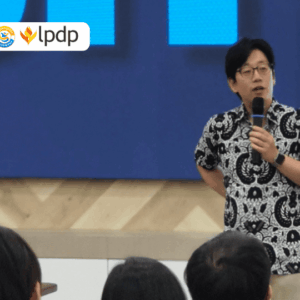
The session, titled “Decarbonize in Iron/Steelmaking Industry: Adoption of Hydrogen and Clean Technologies,” featured Dr. Eng. Muhammad Aziz, Associate Professor from the Institute of Industrial Science, The University of Tokyo. The discussion covered the steel industry’s technology transition from Blast Furnace–Basic Oxygen Furnace (BF–BOF) to Electric Arc Furnace (EAF), the adoption of hydrogen in ironmaking, and low-carbon technology options and carbon capture.
Aziz explained that hydrogen can be used not only as a fuel but also as a reducing agent in the steel production process. However, he emphasized that decarbonization cannot be understood as simply replacing technology, but rather requires a systemic approach that considers system design, energy supply, and carbon management.
“Decarbonizing steel is not just about replacing technology, but a complete system shift, from energy inputs to how emissions are managed and accounted for,” said Aziz.
Aziz also discussed the challenges of carbon capture technologies, including biological approaches like microalgae, absorption technologies, and material-based capture. Aziz explained that while some technologies can capture CO₂ quickly, challenges related to efficiency, process stability, land requirements, and high costs prevent them from being ready for widespread implementation in the steel industry. Furthermore, long-term carbon storage remains risky due to the lack of evidence of geological stability over tens to hundreds of years.
The discussion also highlighted the cost of carbon and its implications for green steel pricing. Steel prices have not fully reflected the costs of capturing and managing emissions. When these costs are factored in, product competitiveness becomes a major challenge.
“Green steel production always involves trade-offs. The lower the targeted emissions, the higher the costs and risks the industry must bear,” said Aziz.
He stressed that there is no one-size-fits-all solution for every country. The decarbonization of the steel industry must be approached gradually and tailored to each specific context, particularly for countries like Indonesia, which have existing industrial assets and limited infrastructure. This session highlighted that the transition to low-carbon steel is a long-term process that requires a realistic strategy, supportive policies, and an industry that is ready for transformation.