The steel industry is one of the largest contributors to carbon emissions in the global industrial sector. Therefore, the transformation to low-carbon steel is an urgent agenda for many countries, including Indonesia.
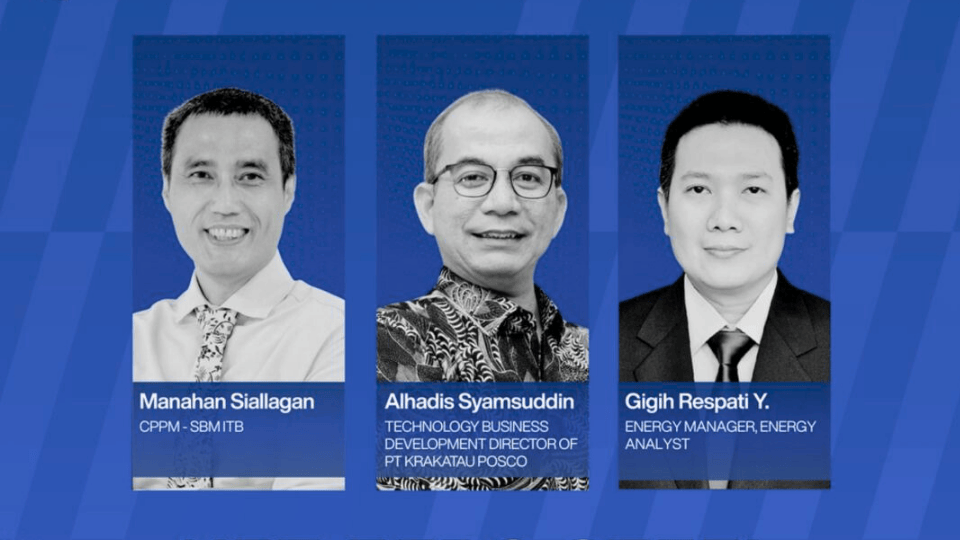
This issue was the focus of the fourth Live Session of the Indonesian Net Zero Steel Pathways Executive Education 2026, organized by SBM ITB, through the Center for Policy and Public Management (CPPM) on Thursday, February 26, 2026, online via Zoom. This session featured Gigih Respati, Energy Analysis Team Leader at PT Krakatau Posco, who presented a presentation entitled “Decarbonization of the Steel Industry: Real-World Application and Strategy.”
Gigih explained that the steel industry is one of the largest contributors to carbon emissions in the global industrial sector, even surpassing sectors such as cement, oil and gas, chemicals, and coal mining.
“The steel industry is the most dominant emitter in the industrial sector globally,” said Gigih.
According to him, countries’ commitments to the 2015 Paris Agreement are driving the acceleration of industrial transformation toward low-carbon manufacturing. This transformation includes developing green technologies, transferring technology, and establishing more sustainable industrial supply chains.
Gigih emphasized that the path to net-zero steel is heavily influenced by supply chain factors, geographic conditions, and each country’s technological readiness. Green steel production, he said, will be highly dependent on electricity availability, which is a major cost component in low-carbon steel production.
He cited Baowu Steel, a Chinese steel company, as an example. It has developed a metallurgical roadmap toward carbon neutrality through energy efficiency, green energy, and the development of low-carbon metallurgical technologies. Some of the innovations developed include HyCROF technology, large-scale CCUS cluster projects, and the Hydrogen Reduction & Electric Smelting Process (HyRESP).
However, in the short term, steel companies can still take practical steps, such as increasing energy efficiency, implementing smart factory concepts, reducing steam leaks, replacing LPG with natural gas, and using artificial intelligence to optimize energy consumption.
Meanwhile, in the Indonesian context, Gigih assessed that the steel industry’s decarbonization process still faces several major challenges. One of these is the significant investment required to transition from blast furnace–basic oxygen furnace (BF-BOF) technology to the lower-emission direct-reduced iron–electric arc furnace (DRI-EAF) route. Furthermore, the industry faces limited financing, the high cost of technologies such as hydrogen and CCUS, and low domestic demand for green steel products.
Other obstacles include limited renewable energy infrastructure, fragmented availability of scrap metal, and the lack of a clear, binding national steel-sector decarbonization roadmap. Furthermore, many conventional steel production facilities are still relatively new. Premature shutdown of these technologies could potentially result in significant financial losses for the industry.
This session concluded a five-week executive education program designed to equip steel industry leaders and executives with strategies for facing the transition to net-zero emissions. The discussion focused on the concrete implementation of steel industry decarbonization strategies, from field practices and stakeholder management to the development of an industry transformation roadmap.
Manahan Siallagan from CPPM SBM ITB emphasized that the main goal of this program is not only to provide conceptual understanding but also to encourage real-world implementation in participating companies.
“We hope that participants will not stop at concepts, but will be able to translate this learning into realistic action plans in their respective organizations,” he said.
Through this closing session, SBM ITB emphasized that the action phase is the most crucial stage in ensuring that decarbonization strategies do not stop at concepts. The Indonesian Net Zero Steel Pathways 2026 program is expected to encourage steel industry leaders to design realistic and collaborative transformation steps towards a more sustainable and competitive national steel industry.