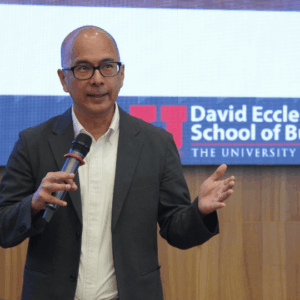
Increasingly fierce job competition demands a selection process that is not only fast but also fair. This was the focus of a guest lecture session on Human Capital Management with Rangga Irawan Prasetyo, Founder & CEO of Nusva Group, at the School of Business and Management, Institut Teknologi Bandung (SBM ITB) (April 23).
In today’s workforce, competition for jobs is increasingly fierce as candidates compete with many other applicants. One of the most challenging stages is the CV screening process, especially given the large number of applicants. This process becomes even more complex when done manually, as it is not only time-consuming but also prone to human error.
“CV screening is one of the most challenging stages due to the high number of applicants. Networking also plays a significant role” he said.
One of the most emphasized points was how digital HC can create a more inclusive process. In conventional practice, opportunities are often influenced by networking, so not all candidates have equal access.
Through digitalization, with more structured screening systems, predictive tools, and assessments, more individuals can be assessed using more objective, measurable parameters. This creates equal opportunities for every candidate.
“They stood in the blazing sun, holding brown envelopes full of hope. Not all of them had an equal chance,” said Rangga.
According to Rangga, digital HC seeks to bridge this gap by creating a more transparent, scalable process that allows organizations to assess more candidates without losing the assessment structure.
“Digital HC can provide inclusivity, help screen more people, and give underprivileged people equal opportunities, even when there are many candidates,” he said.
The students then asked about the possibility of errors in digital systems. Rangga explained that the possibility of errors remains, but the error rate can be minimized and remains more consistent than manual processes that rely heavily on subjectivity. Furthermore, digitalization helps reduce HR’s administrative burden by automating various processes. However, its ultimate effectiveness still depends on how humans use it.
Ultimately, digital HC does not replace human resources but rather strengthens human decision-making. With a more measured approach and an open mindset, digitalization is actually a tool to expand opportunities, especially for those who previously had less access.