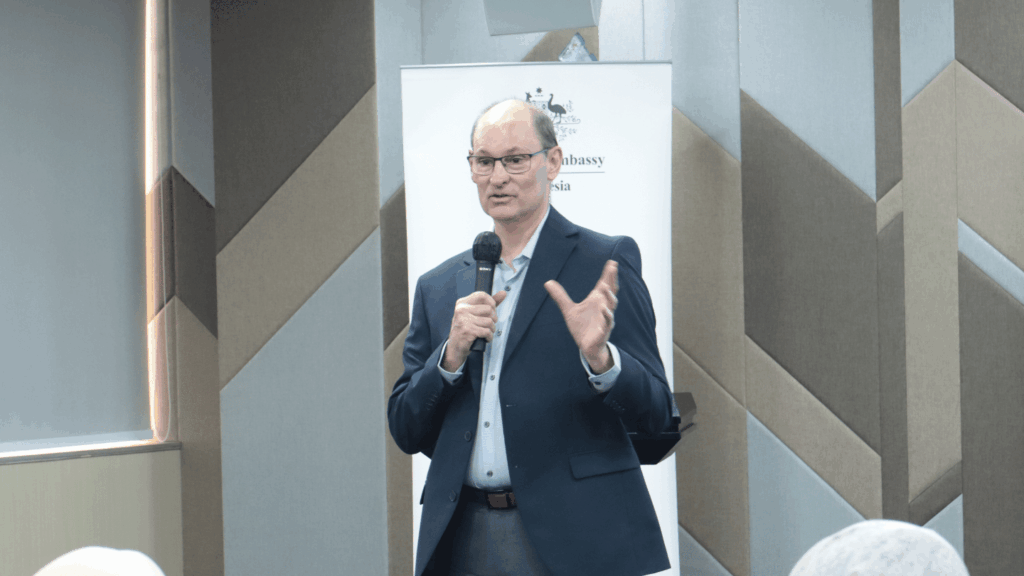
Global businesses are encountering significant challenges due to geopolitical divisions around the world. This was the central theme of the guest lecture titled “The Impact of Global Economic Uncertainty on the Trajectory of Business and Entrepreneurship in Indonesia and Southeast Asia.” The event was organized by the School of Business and Management, Institut Teknologi Bandung (SBM ITB), in Jakarta, in collaboration with the Australian Embassy.
The guest lecture featured Professor Peter Draper, the Executive Director of the Institute for International Trade at the School of Economics and Public Policy, University of Adelaide, Australia. Draper is an expert in international trade and investment policy, with research and consulting experience at the World Bank, the WTO, and the United Nations.
According to Draper, the global trading system is currently being reshaped by three major forces: the transition to a post-US-dominance era, the growing regulatory power of China and the European Union, and the efforts of middle powers like Indonesia and Australia to adapt.
The biggest disruption came from US President Donald Trump, who has shaken up traditional trade rules through the aggressive implementation of reciprocal tariffs. Following the recent meeting between Trump and Xi Jinping in Beijing, both countries have begun moving toward more managed trade and investment.
“We’re moving toward a world of managed trade and investment between the US and China,” said Draper.
Amid this competition, Southeast Asian countries’ room for maneuver is shrinking. According to Draper, maintaining a balance is becoming increasingly difficult. The most realistic path for a country like Indonesia is to engage in multi-alignment based on specific interests while adhering to global trade rules.
“If trade rules aren’t respected, it will create uncertainty, which is bad for business,” Draper stressed.
This uncertainty poses a threat to “Factory Southeast Asia,” an export-driven manufacturing region that relies heavily on foreign investment and access to the US market. At the same time, Southeast Asian supply chains are increasingly dependent on Chinese sources.
“The problem is that while the US is a major export market, Southeast Asian supply chains are increasingly dependent on Chinese sources,” Draper said.
For corporations, this situation makes supply chain optimization increasingly complex. Companies can no longer simply pursue cost efficiency; they must also invest in the ability to monitor trade and investment policies.
Draper also highlighted the fragile global macroeconomic conditions, exacerbated by the conflict in the Gulf region. Rising energy costs are putting pressure on the currencies of Southeast Asian countries, including Malaysia, the Philippines, and Indonesia, while driving inflation and raising the cost of importing necessities.
During a question-and-answer session, Draper stated that Indonesia’s expanding energy subsidy program has raised concerns in international markets and contributed to the depreciation of the rupiah. He also stated that strict local regulations and complex bureaucracy create a “chilling effect” on foreign direct investment.
Concluding the guest lecture, Draper suggested that Indonesia apply for membership in the CPTPP, a mega-regional free trade agreement with 12 countries in the Asia-Pacific region and beyond. The agreement’s members are Australia, Brunei Darussalam, Canada, Chile, Japan, Malaysia, Mexico, New Zealand, Peru, Singapore, Vietnam, and the United Kingdom. Draper views Indonesia’s membership in the CPTPP as an opportunity to expand its market access and to engage with fellow member countries. While still facing regulatory gaps, the process towards membership could be an “imported reform package” to strengthen domestic governance and human resource quality, and to signal long-term economic stability.