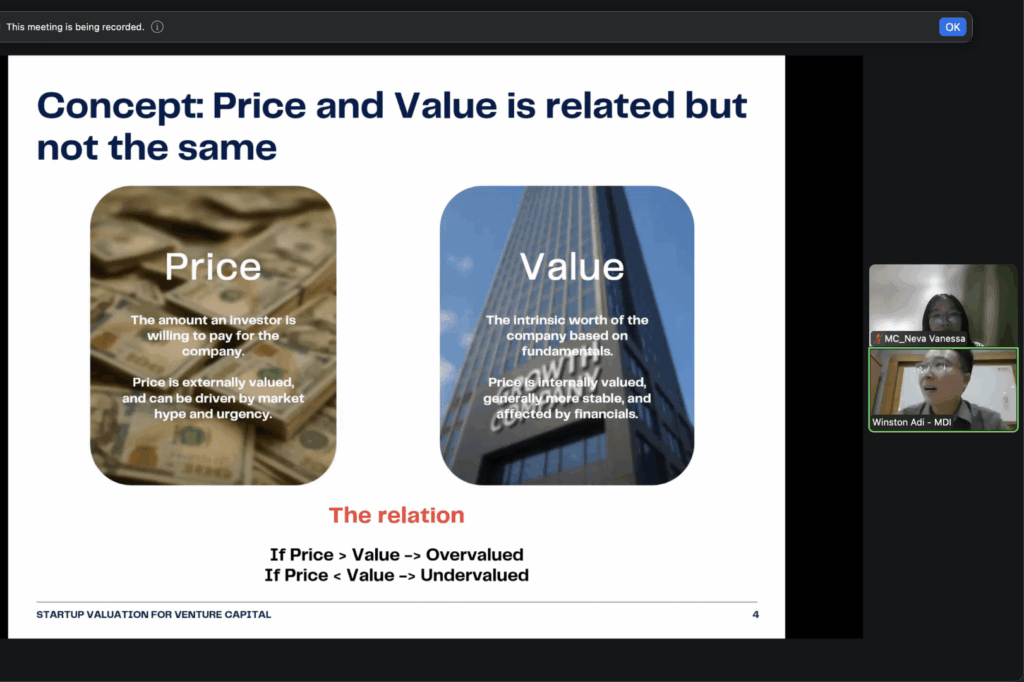
Valuation is a fundamental component of all investment instruments, from stocks and bonds to deposits and mutual funds. The essence of investment ultimately comes down to a company’s value.
“Why is valuation so important? Because companies operating in the capital market, such as stocks, bonds, deposits, mutual funds, everything related to finance, ultimately determine company valuation, whether price and value are aligned,” said Winston Joshua Adi, an experienced venture capitalist with over 10 years of experience in investment, finance, and portfolio management.
The Greater Hub is an academic business incubator affiliated with the School of Business and Management at Institut Teknologi Bandung (SBM ITB). Its mission is to promote innovation and support business development. On Thursday (May 21), the Greater Hub invited Winston to conduct an online workshop titled “Startup Valuation for Venture Capital”
Winston discussed the importance of startup valuation in the world of investment and venture capital. The Greater Hub serves as a collaborative platform that connects startups and SMEs with mentors, industry experts, and investors.
As part of the founding team of MDI Ventures, Winston has overseen more than 60 portfolios with total assets under management (AUM) exceeding US$500 million. He also managed the Indigo Accelerator Network and Telkomsel Ventures. He was involved in the formation of the Merah Putih Fund, which more than five state-owned enterprises backed.
Winston explained that there are two main concepts in valuation: price and value. Market perception of a sector or industry influences prices. For example, when the market believes the artificial intelligence (AI) sector has high prospects, the prices of companies in that sector tend to increase.
Meanwhile, value refers to a company’s intrinsic value over a specific period. According to Winston, a company is overvalued when its market price exceeds its true value, and undervalued when its market price is below its true value.
“Valuation needs to be checked regularly because it will reveal the company’s worth,” he added.
In his presentation, Winston explained three main approaches to startup valuation: the market-based, projection-based, and assumption-based approaches.
The first approach is the market-based approach using the Global Public Comparable Multiple (GPCM) method. This method compares the company with similar public companies in the market. In practice, investors typically use multiples, such as EV/EBITDA or revenue multiples to determine a company’s value.
The second approach is the projection-based approach, which uses the Discounted Cash Flow (DCF) and VC Methods. In the DCF method, valuation is calculated based on the company’s projected future cash flows, which are then discounted to the present value.
Winston explained in his technical presentation that free cash flow is calculated for the first year and continues up to the fifth year. Typically, a minimum of five years is considered because the figures tend to stabilize after that period.
He also explained that the discounting process uses a specific discount rate that reflects the company’s risk and investor confidence.
“From an investor’s perspective, they would certainly prefer a higher discount rate because it lowers the enterprise value. Meanwhile, entrepreneurs want a lower discount rate to increase the enterprise value,” he said.
Meanwhile, the third approach is the assumption-based approach, which includes the Cost to Duplicate method and the Scorecard Method. This approach is considered more suitable for early-stage startups (ideation stage) that lack sufficient historical data and financial projections.
Winston also highlighted that the choice of valuation method depends heavily on the company’s development stage. Startups in the ideation and early stages generally face high risk and limited data, so they rely more on assumptions and investor confidence. Conversely, companies in the growth and late-stage stages are considered to have more mature data, allowing for the use of projection-based approaches and market comparisons.
Through this activity, The Greater Hub hopes that participants will understand how venture capitalists value startups and the importance of understanding the relationship between market price and a company’s intrinsic value in making investment decisions.