Energy has long been a vital foundation for human well-being and economic growth. However, fossil fuel-based energy systems are also a major cause of rising global temperatures and the climate crisis.
Amid these challenges, Lord Adair Turner, Chair of the Energy Transitions Commission, believes the world is experiencing a major revolution in clean energy technology. The decline in the cost of solar panels, lithium-ion batteries, and energy storage systems over the past few years has made renewable energy increasingly competitive and efficient.
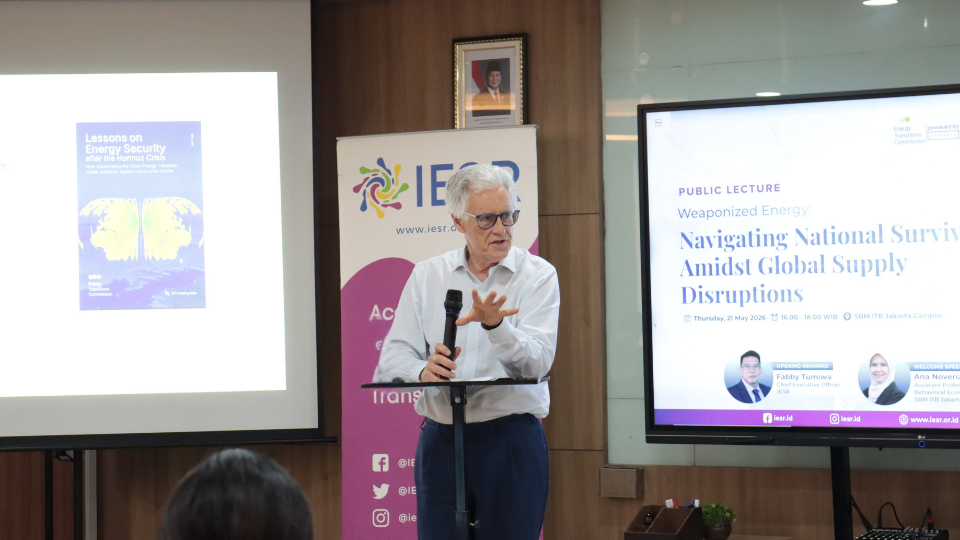
“The question today is no longer whether renewable energy is possible, but how far and how fast we can scale this revolution,” said Turner while speaking at a public lecture entitled “Navigating National Survival Amidst Global Supply Disruptions,” organized by the School of Business and Management, Institut Teknologi Bandung (SBM ITB), Jakarta Campus, in collaboration with the Institute for Essential Service Reform (IESR) in Jakarta (May 21).
He explained how the development of electric vehicles and battery technology demonstrates global efforts to create a more efficient and sustainable energy system. In the Indonesian context, he also highlighted that national solar energy development still lags behind countries like India due to high land costs, limited electricity transmission, and high project costs.
According to Turner, the energy transition is no longer just a long-term discourse but a major change underway across the world. Amid uncertainty in global supply chains and rising geopolitical tensions, energy is increasingly seen as a crucial element of economic resilience, national stability, and Indonesia’s future direction.
IESR Executive Director Fabby Tumiwa emphasized that the increasing tensions in the Middle East and the closure of the Strait of Hormuz illustrate that oil and gas are not just energy sources; they also serve as instruments of global power and create vulnerabilities for many countries. These global geopolitical tensions once again demonstrate how energy is closely linked to national resilience and economic stability. Therefore, Indonesia needs to respond to the increasing uncertainty in the global energy supply chain caused by the war by accelerating its efforts toward energy independence.
“Let’s be honest about our position and develop an honest and effective strategy,” he said in his opening remarks.
Fabby explained that rising global oil prices, the swelling energy subsidy budget, and the weakening exchange rate indicate that Indonesia remains vulnerable to global energy volatility. On the other hand, Indonesia is considered to have significant renewable energy potential across its archipelago, but it has not yet been fully utilized optimally. He argued that the energy transition can no longer be viewed solely as an environmental agenda.
“The energy transition involves not only energy source replacement but also a fundamental restructuring of civilization itself, and it is occurring now, everywhere, regardless of our awareness,” he stated.
He also emphasized that the energy transition needs to be treated as part of a national resilience strategy for the future.
Ana Noveria, Ph.D., Assistant Professor of Behavioral Economics at SBM ITB Jakarta, invited participants to consider how Indonesia’s future will be greatly influenced by the country’s ability to face increasingly complex global energy and economic challenges.