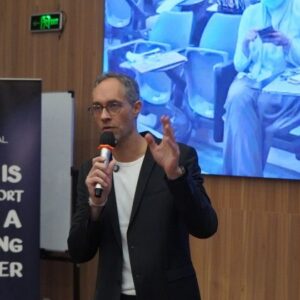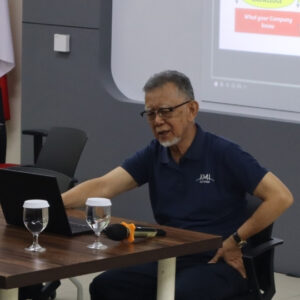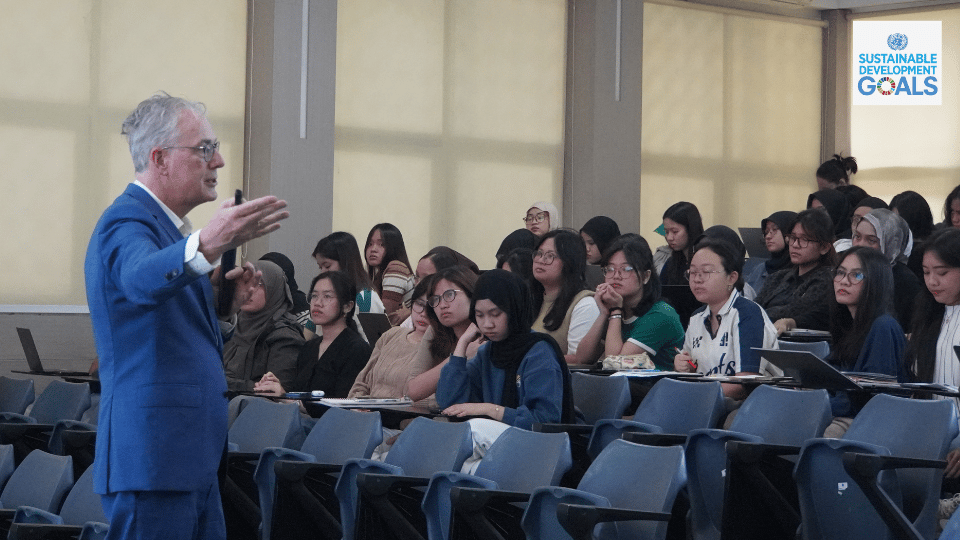
Prof. Dr. Ir. Eric van Heck from the Rotterdam School of Management (RSM), Erasmus University, encouraged students from the School of Business and Management, Institut Teknologi Bandung (SBM ITB), to produce research that is not only academically sound but also provides real value to the business world.
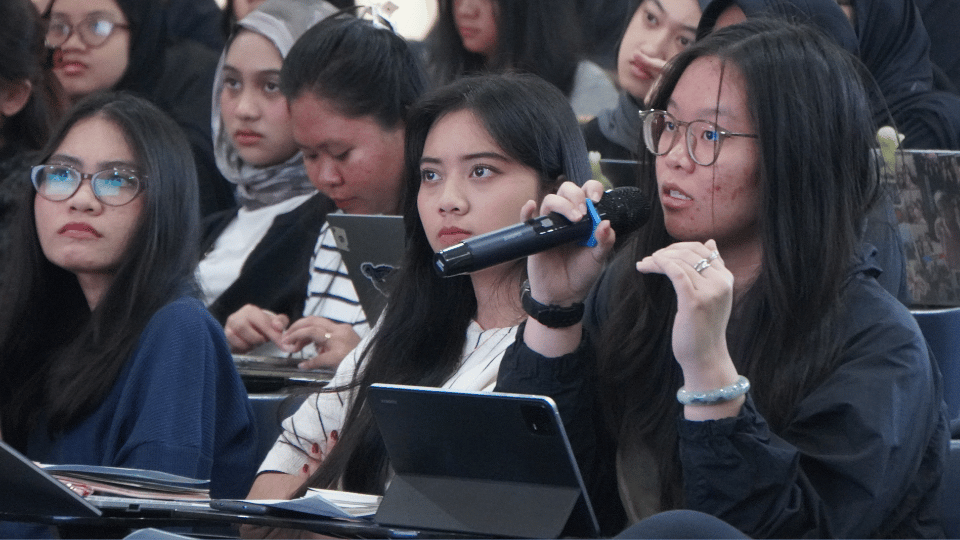
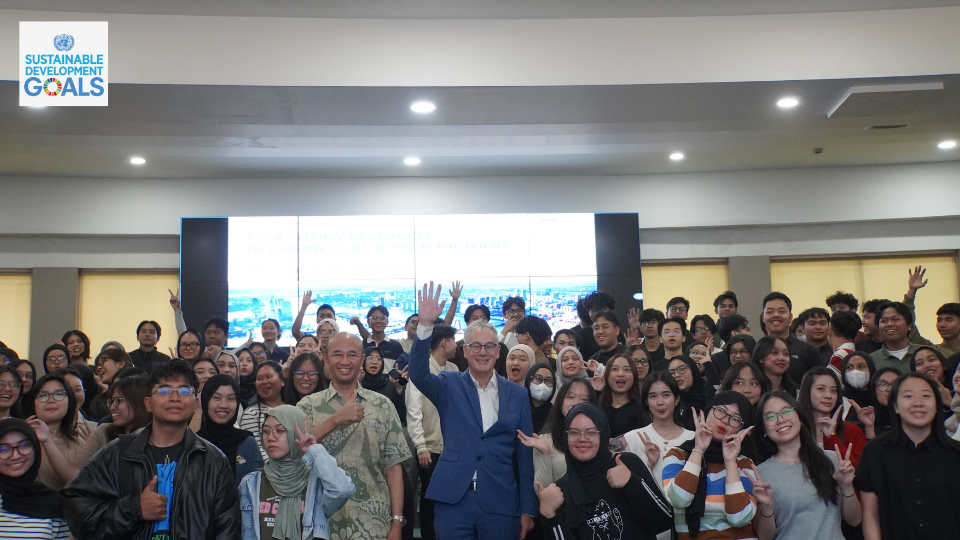
This message was delivered during a guest lecture titled “Case Study Research” in the Business Research Methods (BRM) course, held in the 2nd Floor Auditorium of the SBM Building, ITB on Monday (July 13). In the class, students learned the principles of systematic case study research and their application to address complex business problems.
Van Heck explained that case study research aims to deeply understand a phenomenon in a real-world context, rather than simply generating broadly generalizable conclusions. This method is appropriate for answering “how” and “why” questions, especially in complex organizational situations or when existing theories are unable to fully explain a phenomenon.
He also corrected the notion that case study research is not as rigorous as survey-based research.
“Case study research can be conducted very rigorously as long as the researcher follows the correct methodology,” he said.
According to Van Heck, case study research still follows a systematic scientific methodology. The process includes formulating a research proposition, selecting an appropriate case, collecting data through interviews, observations, company reports, and other supporting sources, and analyzing all the evidence obtained.
Unlike research that selects a sample to represent the population, case study research selects cases that can provide the most in-depth understanding of a phenomenon. Therefore, this method uses analytical generalizations, not statistical generalizations.
Van Heck also emphasized that case study research is not limited to qualitative approaches. This method can combine qualitative and quantitative approaches using various data sources, ranging from interviews and observations to company reports, internal documents, and relevant media information. This diversity of evidence sources can strengthen the quality of research results.
To demonstrate its application, Van Heck presented multiple case study research on alignment between business teams and information technology teams in several company projects. Through this example, he encouraged students not to immediately accept existing assumptions, but to critically analyze evidence and develop theories based on real-world phenomena.
Van Heck then encouraged students to choose topics that align with their personal interests and are also beneficial to industry.
“Identify a field that genuinely interests you, address issues in the industry or business sector, and demonstrate to companies how your thesis research can provide them with added value, ” he advised.
He also advised students to build relationships with SBM ITB alumni working in various industries. This step is considered to help students identify relevant issues for research and strengthen collaboration between academia and industry.
At the end of the session, Van Heck expressed his hope that more students would use the case study method in preparing their final assignments. By directly engaging with organizations and examining current business challenges, students can deepen their academic understanding while generating theories, findings, and recommendations that benefit the business world and society.
Written by Student Reporter (Muhammad Rafi Rashad Budiman, Management 2027)