Food, medicine, and shelter are among the most urgent needs when disaster strikes. However, effective disaster management depends not only on the availability of these essential resources but also on strong leadership and clear communication.
Without timely and reliable information, aid distribution is delayed, inter-agency coordination weakens, and public trust begins to erode.
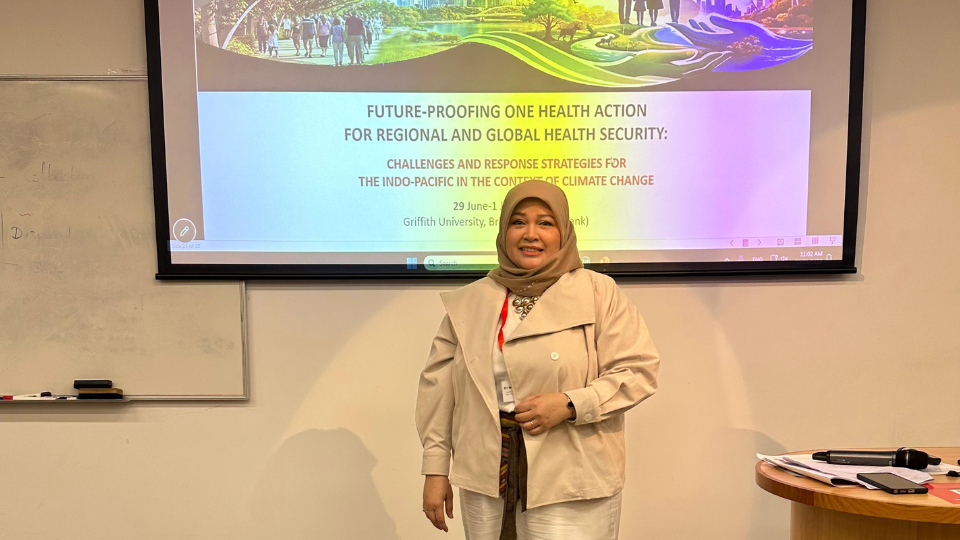
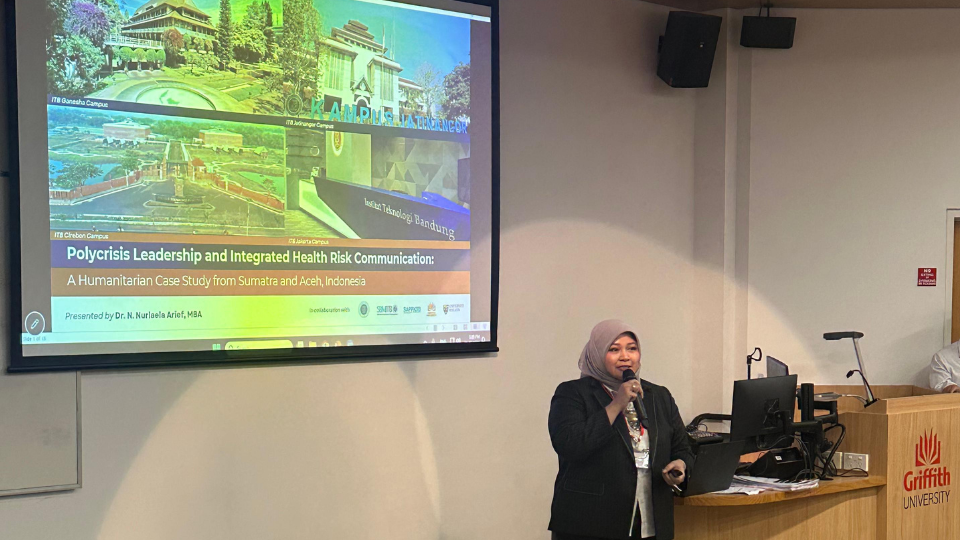
These challenges are at the heart of research conducted by Nurlaela Arief, a lecturer at the School of Business and Management, Institut Teknologi Bandung (SBM ITB). Using flood management in Aceh and Sumatra as case studies, she examined how leadership and communication influence disaster response in complex emergency situations. Her findings were presented at the international symposium, Futureproofing One Health Action for Regional and Global Health Security, held at Griffith University, Australia, from June 30 to July 1, 2026.
“Our contribution is understanding the human side: how leaders make decisions, communicate risks, and minimize casualties during disasters,” said Nurlaela in Bandung, July 14, 2026.
Facing Interconnected Crises
Flooding in Aceh and Sumatra not only damaged settlements but also disrupted transportation and logistics distribution routes. As a result, access to health services, food, humanitarian aid, and information was limited.
This situation illustrates a polycrisis, in which multiple crises occur simultaneously and reinforce one another. Flooding damages roads, disrupted transportation hinders the distribution of aid, limited access to healthcare increases the risk of disease outbreaks, and misinformation amplifies public anxiety.
“Climate change not only poses environmental problems, but also humanitarian, social, health, and governance challenges that require integrated solutions,” said Nurlaela.
This research combined field observations, interviews with governors, regents, and community leaders, monitoring public sentiment on social media, and a survey of 83 young leaders from government and industry.
The results show that effective disaster response requires rapid decision-making, cross-sector collaboration, and clear and transparent communication.
One finding comes from Aceh Tamiang. When formal procedures slowed aid, some local leaders leveraged personal networks and collaborated with private companies to provide helicopters for logistics distribution to remote areas.
“Formal processes sometimes take too long. Some leaders chose to act immediately because the community needed help immediately,” said Nurlaela.
Communication Builds Trust
The study concluded that disaster management is not only about sending aid, but also about building public trust.
Responsive, active, and transparent leaders tend to receive a more positive public response. Conversely, poor communication can trigger confusion, panic, and the spread of misinformation.
Nurlaela also introduced the Integrated Risk Communication framework being developed through the research. This framework emphasizes coordination between the central government, local governments, the business sector, and the community to ensure accurate information is quickly disseminated to the public.
This model does not rely solely on one-way information delivery, but also encourages preparedness, ongoing coordination, and community engagement before, during, and after a disaster.
Aceh’s experience demonstrates that disasters are not solely about infrastructure damage. Their management is also determined by the quality of leadership, speed of decision-making, and the ability to build trust.
This research hopes that Indonesia’s local experience can enrich the global discussion on risk communication and resilience in the face of climate disasters.