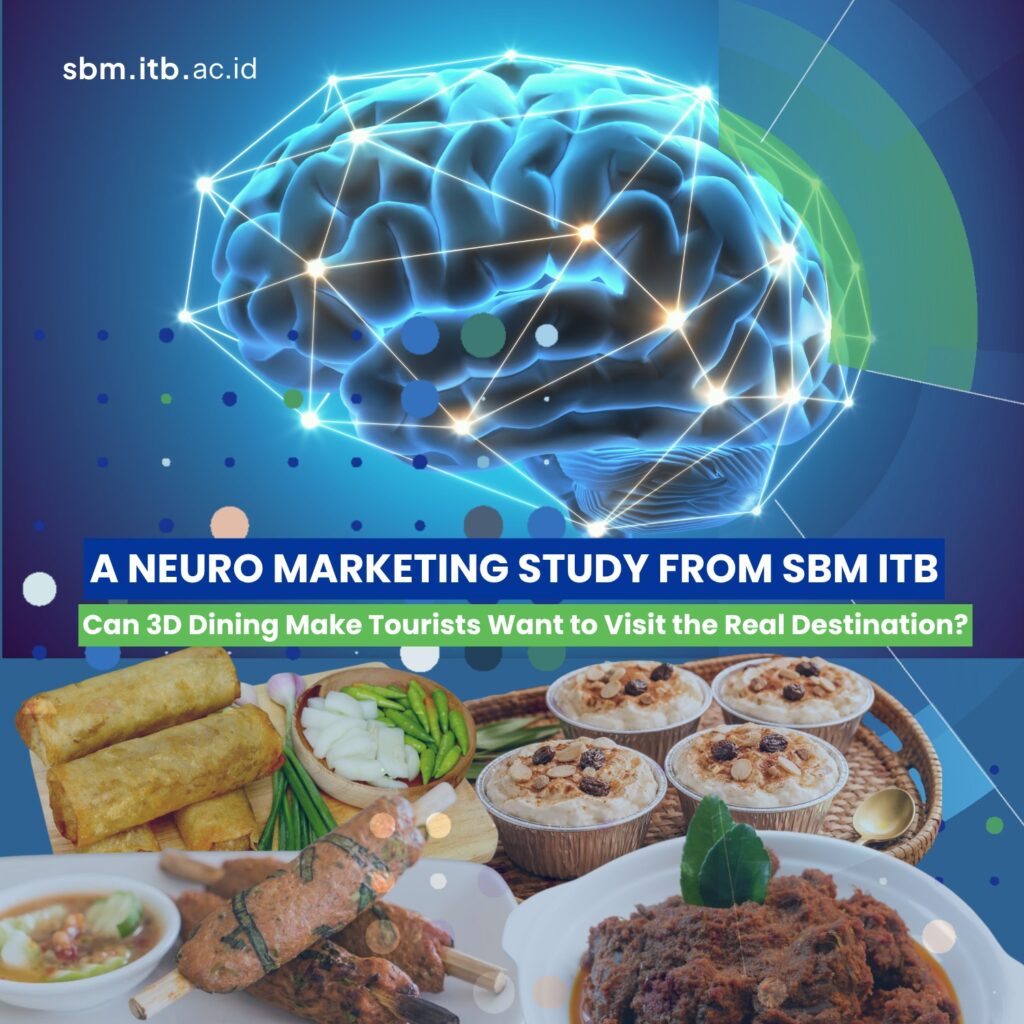
Immersive dining may not necessarily make food taste better, but it could make people more interested in visiting the destinations where their food comes from.
That is one of major findings in a study titled “Improving gastro-tourism experience through 3D virtual attractions: evidence from tourists’ self-reported and neurophysiological responses,” published in the Journal of Hospitality and Tourism Technology.
The research was conducted by Mustika Sufiati Purwanegara, Nila Armelia Windasari, Hasbian Fauzy Perdhana, Muhammad Fakhrul Rozi Ashadi, and Fitri Aprilianty. The study examined how immersive 3D technology can shape the gastro-tourism experience before, during, and after a dining encounter.
Rather than focusing only on food quality and satisfaction, the researchers also looked at whether an immersive dining experience could influence tourists’ intention to visit the destinations associated with the food.
This research involved 23 Generation Z, born in 1997 to 2012 participants who had never experienced a 3D immersive culinary event. Eleven participants were assigned to the 3D experience group, while 12 were placed in a control group.
Both groups were served four Indonesian dishes: Lumpia Semarang from Central Java, Sate Lilit with fish soup from Bali, Rendang from West Sumatra, and Klapertart from Manado.
What differed was the experience surrounding the food.
Participants in the 3D group were exposed to visual projections, animation, storytelling, and sound related to the dishes. Before visiting the restaurant, they also viewed content from social media (TikTok) presenting the 3D immersive culinary experience. The control group received text-based information and experienced conventional fine dining.
The researchers also used electroencephalography (EEG) to record participants’ brain activity during different stages of the experience.
The effect appeared even before participants tasted the food. Those exposed to the 3D experience reported higher expectations, with an average score of 4.34 compared with 3.59 in the control group.
However, the immersive experience did not significantly change how participants perceived the food or how satisfied they were with the meal. Food perception averaged 4.09 in the 3D group and 4.15 in the control group, while satisfaction scores were 4.31 and 4.54, respectively.
The more significant difference appeared after the meal.
Participants who experienced the 3D attraction reported a stronger intention to visit the destinations associated with the food. Their average visit-intention score was 4.00, compared with 3.00 in the control group.
The EEG results also showed differences in brain activity during the immersive experience and afterward. The researchers identified activity in several brain regions associated with attention, preference, cognitive-emotional processing, and learning and memory.
The findings suggest that the value of immersive dining may not necessarily come from improving the perceived quality of food. Instead, the technology may help strengthen the connection between a dish and the destination behind it.
But why does visiting the destination behind the food matter?
Food is often closely connected to the history, culture, people, environment, and traditions of a particular place. For example, eating Rendang provides a taste of a dish, but visiting West Sumatra can offer a much broader understanding of the culture and traditions that shaped the taste of Rendang.
The same things applies to other regional foods. Visiting Semarang, Bali, or Manado allows tourists to experience the communities, landscapes, local traditions, and cultural practices that cannot be fully experienced through a dish alone.
In this sense, gastro-tourism can create a bridge between consumption and cultural exploration. The food becomes the first point of curiosity, while the destination provides the wider context behind what tourists have tasted.
This creates an interesting opportunity for gastro-tourism.
A restaurant serving Rendang, for example, could go beyond presenting the dish itself. Through visual storytelling, sound, animation, and cultural narratives, the dining experience could also introduce visitors to West Sumatra including the culture and the origins of the food.
The same approach could be applied to other regional dishes. Food can become more than something tourists consume; it can become a starting point for discovering the place, culture, and stories associated with it.
For tourism businesses, this means immersive technology does not necessarily need to be evaluated only by whether it increases customer satisfaction. Its value may also lie in whether it makes a destination more memorable and encourages people to experience it in person.
The researchers, however, noted that the study involved only 23 Generation Z participants. Further research is needed to determine whether similar effects would appear among different groups of tourists and whether the impact remains after the novelty of immersive 3D technology wears off.
The study ultimately offers a different way of thinking about technology in gastro-tourism. The question is not only whether technology can make dining better.
It may also be whether a dining experience can make people curious enough to visit the place where their food comes from.