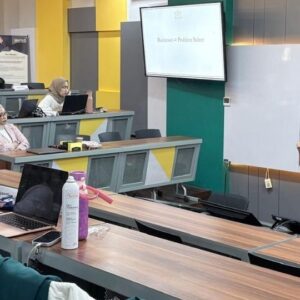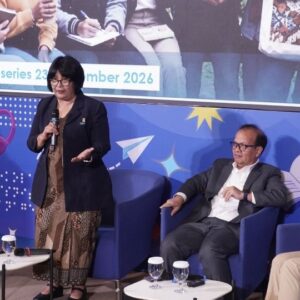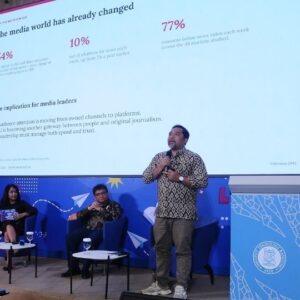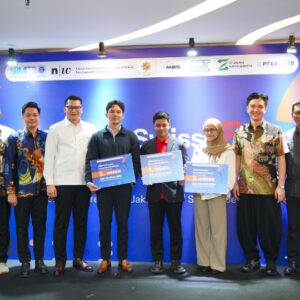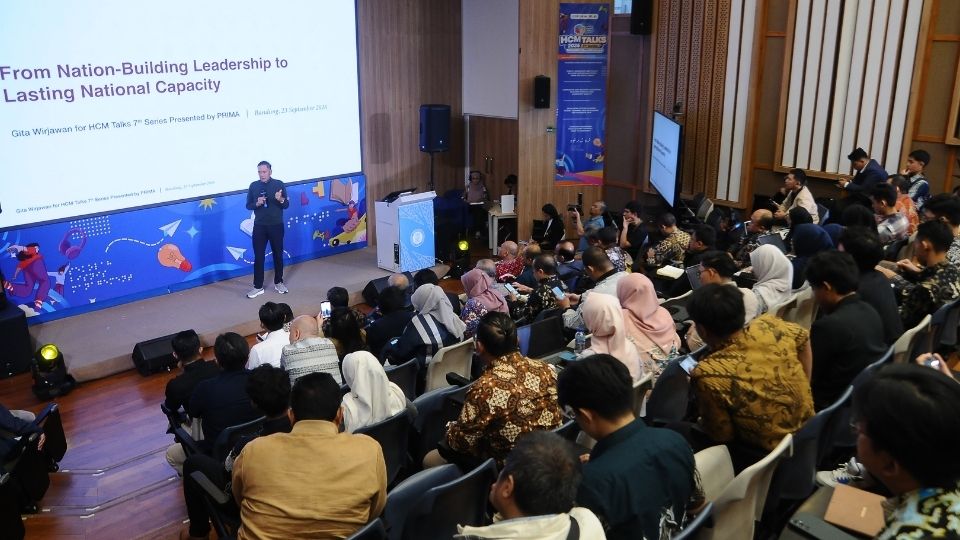
Leadership towards a Golden Indonesia 2045 requires performance-oriented governance, equitable public services, investment in education, and empathy. These issues emerged during the 7th HCM Talks Series 2026 at the Freeport Building, SBM ITB, on Wednesday (September 23, 2026).
The event, themed “Leadership Development Across Fields and Levels Toward a Golden Indonesia 2045,” brought together students, professionals, academics, and practitioners. SBM ITB, the ITB Alumni Association, and PRIMA Indonesia through PT Rintis Sejahtera organised the event in collaboration.
In the session “Public Leadership and Policy: Building Indonesian People from the Policy Space,” PT Rintis Sejahtera President Director Abraham J. Adriaansz, an ITB Industrial Engineering alumnus (1980), emphasized that impactful leadership is inseparable from quality governance.
“Good governance is not just about compliance; good governance ultimately leads to performance,” he said.
According to Abraham, leaders must inspire, share their vision, and dare to challenge existing conditions to find better solutions. Leaders also shouldn’t always be the center of attention, but should give others space to act and share ideas.
“Empower others to act,” he said.
Abraham encouraged students to build leadership experience through organizations and activities outside the classroom. These activities aren’t just for adding to their resumes, but also a way to learn to collaborate, understand issues, and build awareness. He believes that complete leadership begins with the ability to be a role model and care for the surrounding environment, including Indonesia, one’s family, and the institutions in which one grows up.
Meanwhile, Ancora Group Chairman and former Minister of Trade, Gita Wirjawan, highlighted the importance of equitable access to public goods in human development. According to Gita, democracy’s success cannot be measured solely by population size or the exercise of political rights. The state must also ensure that people have more equitable access to education, infrastructure, health care, welfare, and moral and social values.
He believes that development between regions in Indonesia remains unequal. Therefore, human development policies should not only focus on major cities but should also expand access and improve the quality of public services across various regions.
Gita also emphasized the importance of long-term investment in education and talent development. These investments determine a country’s ability to produce innovation, technology, and leaders in various sectors.
Beyond capacity, leaders also need empathy. Using Satya Nadella’s leadership at Microsoft as an example, Gita explained that an institution’s success also depends on a leader’s ability to understand the people within and around the organization.
“Never underestimate the power of empathy,” he said.
This empathy, Gita continued, applies not only to relationships with employees, but also with customers, suppliers, colleagues, the community, and the nation.
PT Badak NGL Chairman Daniel Purba, who attended as a commentator, linked this idea to leadership in the industrial world. He highlighted the relationship between policy, governance, talent development, and an organization’s ability to adapt.
In an industry that requires competence, disciplined governance, and sustainability, human development is crucial to navigating change and maintaining long-term performance.
The discussion, moderated by Fajar Hendarman, a lecturer at SBM ITB, emphasized that leadership is not just about position. Leadership also involves building people and institutions through governance, empowerment, equitable distribution of public services, education, and empathy.