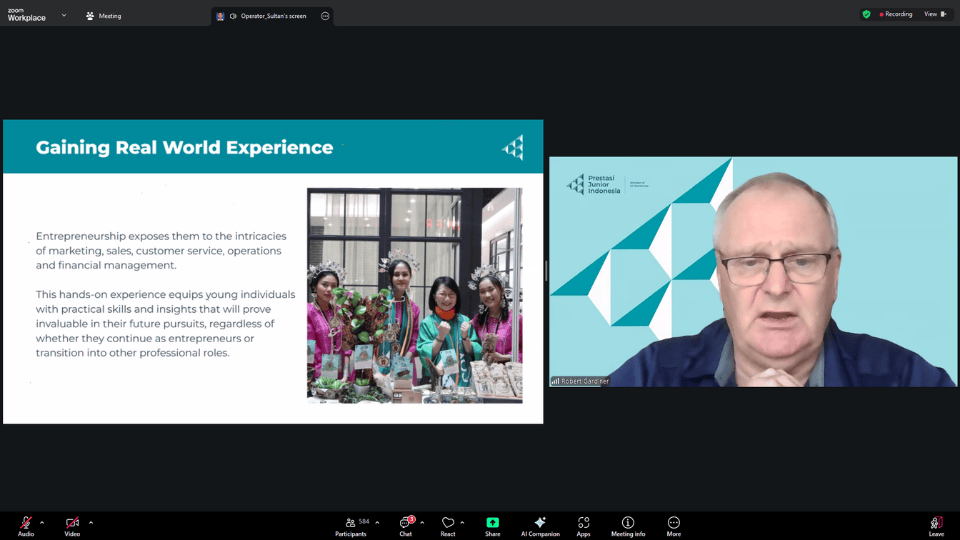
Robert Gardiner, Co-Founder and Operations Counsel of Prestasi Junior Indonesia, stated that more than 3 million students in Indonesia have great potential to become successful entrepreneurs. Therefore, Gardiner emphasized three points that young people must follow to build a successful business.
First, in product design, innovation is needed in the form of a truly new product that can create market demand and interest. Second, the product created does not have to be completely new. Existing products or services can be improved. Finally, we can create the same product at a lower price than competitors, while still maintaining product quality.
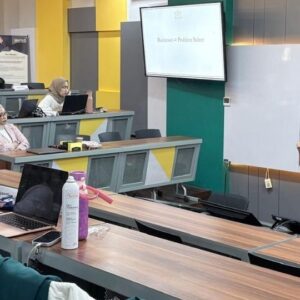
“As an entrepreneur, thinking outside the box is crucial. An entrepreneur must be able to learn and bounce back from failure; they must never give up easily,” Gardiner stated while speaking at the International High School Business Plan Competition (IHSBPC) Workshop at the SBM ITB Bandung Campus on Sunday (February 15).
This workshop provided initial training for participants in the 2026 Ganesha Business Festival (GBF) business competition, organized by The Management Student Family of ITB (KMM ITB) and Artha ITB Entrepreneurship Student Association (IMK “Artha”). This year’s competition carried the theme “Empowering the Next Generation of Entrepreneurs.”
Gardiner gave an example: a handbag with a shiny appearance. The bag was made from used inner tubes, which served as the raw material. Through cutting and processing, a student company called Sevasco transformed the material into a unique handbag.
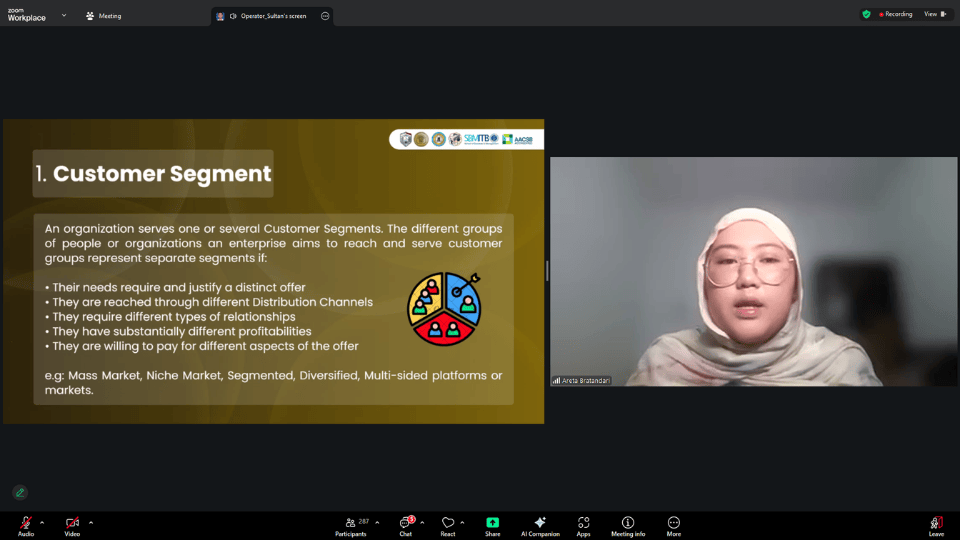
Meanwhile, Areta Bratandari, Chief Executive Officer & Founder of Etthra Hijab Wear, explained the Business Model Canvas for aspiring student entrepreneurs.
“The BMC is designed so that even the general public can understand it,” she explained.
Areta outlined nine key elements that explain how a company operates and generates profits. She emphasized that customer segments must be structured in detail without generalizations, as not all customers have the same needs and problems.
After identifying customer needs, a value proposition is developed to solve customer problems. This element is crucial for differentiating a business from its competitors. Similar to Robert’s explanation, Areta also stated that the product created must be different and “special” compared to competitors to add value and attract customers.
An equally important element in developing a BMC is the cost structure. In creating a business model, costs must be managed efficiently while revenues are increased to achieve profitability. Areta also explained that there are two cost structures: cost-driven, which focuses on keeping costs as low as possible, and value-driven, which emphasizes creating product value without overemphasizing costs.
After outlining the elements of the BMC, Areta showed an example of a BMC implemented in a beverage business targeting millennials. Areta recommended the book “Business Model Generation” as a guide to developing a good business model.
Contributions to the SDGs :
Empowers young students with practical entrepreneurial skills, business model design frameworks, and sustainable product innovation capabilities to foster creative problem-solving, upcycling initiatives, and youth-led economic growth.
#SDG8 #SDG4 #SDG9 #SDG12