Tourism has become a major economic driver for many countries. However, Associate Professor Dimitrios Stylidis from Democritus University of Thrace has warned that the commercialization of tourism may lead to the risk of “over-tourism.” He cited Greece as an example, where a population of 10 million must accommodate 40 million visitors annually.
He emphasized that the phenomenon of “IKEA-fication” in tourism, the standardization of uniform accommodations and the loss of character, is a threat to a destination’s authenticity. Instead, he encouraged a focus on the ancient Greek concept of Philoxenia (the etiquette of hospitality toward strangers) and on quality interactions between locals and tourists.
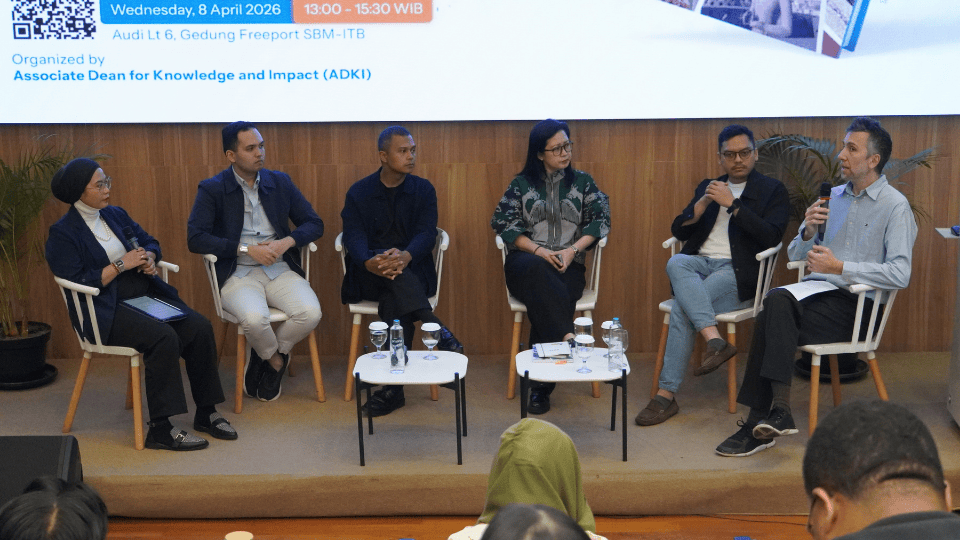
Stylidis made this statement while delivering a guest lecture on international tourism. He also served as a reviewer at the book launch of “Marketing for Hospitality and Tourism with Case Studies from Indonesia.” This event was hosted by the Associate Dean for Knowledge and Impact (ADKI) at the School of Business and Management, Institut Teknologi Bandung (SBM ITB), on Wednesday, April 8th, and was conducted as a hybrid event.
The guest lecture and book review brought together academics, students, and practitioners from the National Institute of Tourism (NHI), Bandung Polytechnic of Tourism (Poltekpar), Pradita University, and other global participants to examine the future of the tourism industry.
This book is the result of a collaboration between five authors representing a fusion of academia and industry: Ilma Aulia Zaim (SBM ITB), Mochamad Nalendra (Wise Steps Consulting), Nenden Dianawati (NHI Bandung Polytechnic of Tourism), Galang Perdhana Dalimunthe (SBM ITB), and Johann W.H. Prawiro (Pradita University).
Ilma explained that her motivation for writing this book was to provide a reference source for Indonesian students to avoid being too Western-centric.
In the book, the authors explore the complexities of tourism in Indonesia. One key discussion point is Bali’s current status, which appears to be in the decline phase of its tourism life cycle, largely due to market saturation.
Mochamad Nalendra argues that the tourism industry must move beyond mere sustainability to improve destinations actively.
“Marketing shouldn’t just be about attracting crowds; it should be about capturing the right value,” Nalendra said.
Meanwhile, Galang and Johann Prawiro emphasize that “agility” is the most crucial skill for modern tourism professionals. Artificial intelligence (AI) can streamline marketing, but the “human touch” of Indonesian hospitality remains irreplaceable.
Stylidis praised the authors for publishing the book in English, highlighting that it offers valuable insights into the Indonesian context for researchers worldwide.