The transition of the steel industry to low-carbon production demands technological readiness, a competitive energy supply, and an improved supply chain. These challenges are vital because the steel industry serves as a key supplier of raw materials for many economic sectors, including infrastructure, manufacturing, and national logistics.
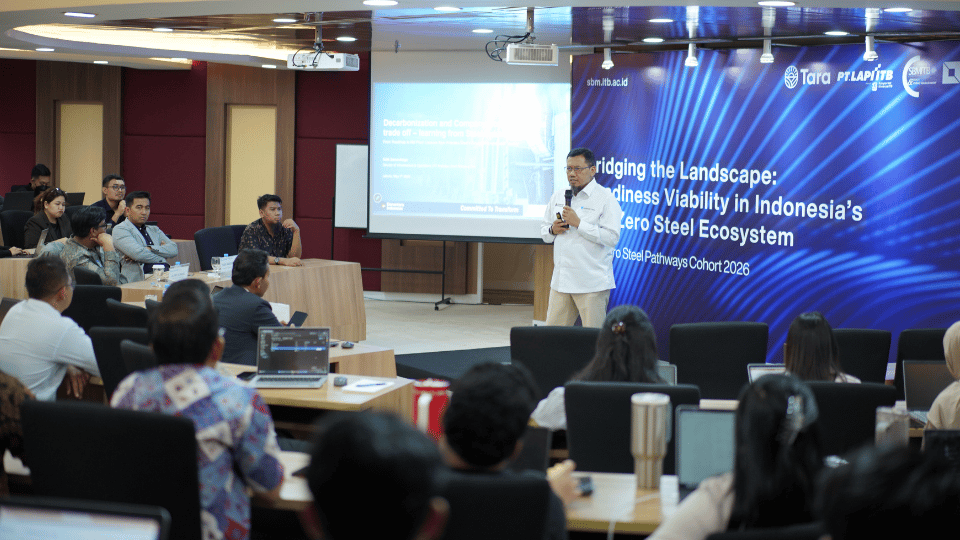
Dr. Sidik Darusulistyo, Chief Operating Officer of PT Krakatau Steel Tbk, stated that the national steel industry is currently in a complex situation. The company needs to support the decarbonization agenda while simultaneously maintaining efficiency, business sustainability, and competitiveness amidst global market dynamics.
“Decision-making in the steel industry is heavily influenced by technological maturity, cost competitiveness, raw material availability, and calculating return on investment,” Sidik said at the Grand Final of the Net Zero Steel Pathways Cohort 2026 held by CPPM SBM ITB on Thursday (May 7).
Krakatau Steel, as noted by Sidik, is currently working to enhance its operational efficiency. A key focus of the company is to speed up the cash conversion cycle by improving work-in-process and inventory management. This initiative has been implemented to sustain the company’s operational performance despite pressures from rising production costs.
Furthermore, Krakatau Steel also simplified its business structure by streamlining several subholdings. This effort aims to make the organization more efficient and accelerate decision-making processes.
Within its sustainability agenda, Krakatau Steel has begun adopting the green industry concept since 2019 through the use of electric arc furnace (EAF) technology. However, implementing low-carbon technologies still requires stable, competitive energy support for optimal operation.
Sidik explained that Krakatau Steel’s DRI-EAF-based production had an emissions intensity of around 2.2 tons of carbon dioxide per ton of steel in 2018. However, increasing production volume can still affect overall emissions.
Therefore, supply chain management is a crucial part of the decarbonization strategy. According to Sidik, supplier selection, raw material availability, and logistics efficiency are crucial for the steel industry’s success in reducing its carbon footprint.
The national steel industry faces intense global competition. With large steel production capacity, particularly from China, industry players must continually enhance efficiency and reinforce their position within the domestic supply chain.
To support domestic industrial demand, Krakatau Steel is reactivating the processing of imported raw materials. This step aims to increase supply efficiency and strengthen the sustainability of the national steel supply chain.
Sidik stated that current discussions on the energy transition no longer focus solely on the net-zero emissions target. The industry also needs to consider the energy trilemma, namely the balance between energy security, affordability, and sustainability.
“This requires us to focus not only on environmentally friendly products, but also consider sales value and resource procurement,” he said.
According to Sidik, oil and gas will still play a role in the energy transition period in several sectors. Fossil fuels cannot be completely abandoned, especially while the industry is still developing new technologies such as hydrogen and various other low-carbon innovations.
Yudo Anggoro, M.S.M., Ph.D., Head of CPPM at SBM ITB, stated that the steel industry is confronted with a significant challenge: balancing the decarbonization agenda with the need for business sustainability. He explained that rising natural gas prices, limited resources, and the demand for operational efficiency mean that the transition to green steel must occur gradually.
Yudo believes that the success of the steel industry’s transition is determined not only by technology but also by the readiness of the industry’s overall ecosystem. This includes energy, raw materials, investment, markets, and the industry’s ability to maintain long-term competitiveness.