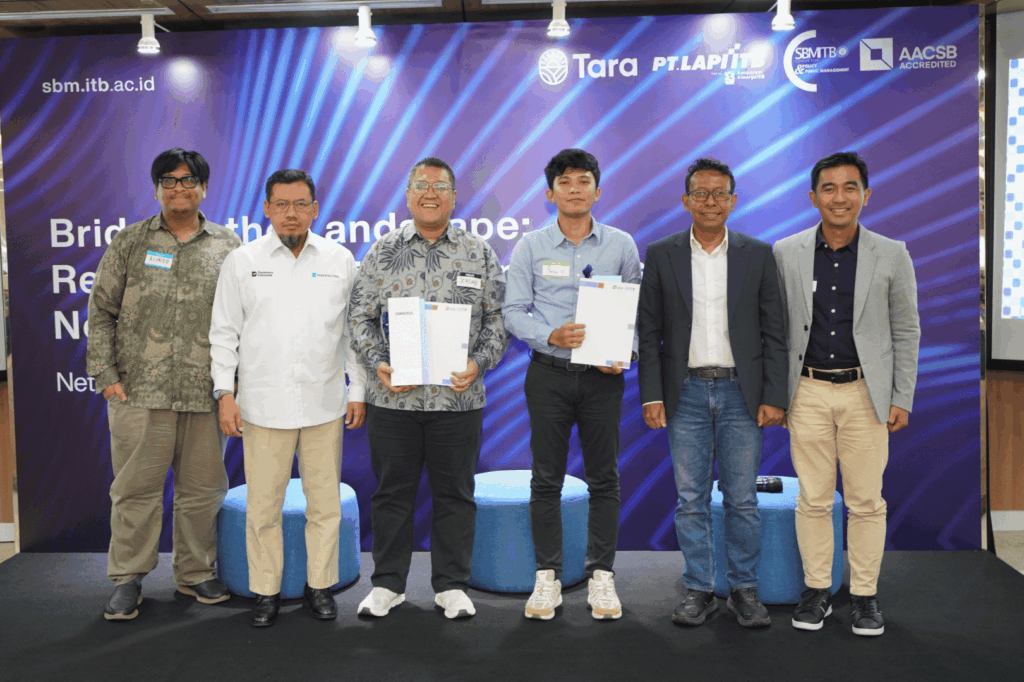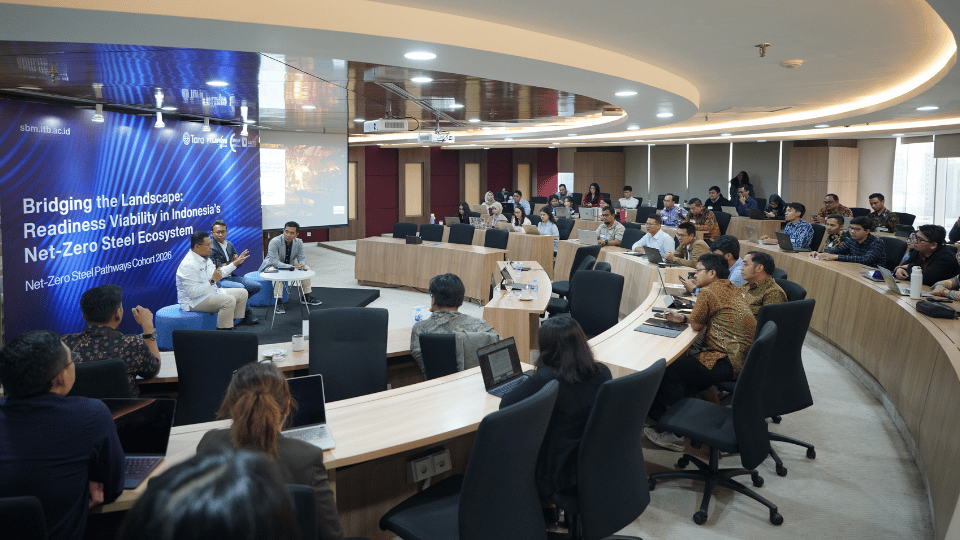
The Center for Policy and Public Management (CPPM) of the School of Business and Management, Bandung Institute of Technology (SBM ITB), held the Grand Final Gathering of the Net Zero Steel Pathways Cohort 2026 as the culmination of a three-month executive education program on Thursday (May 7) in Bandung.
This program is designed to strengthen steel industry executives’ understanding of the transformation towards a net-zero steel ecosystem in Indonesia, covering technology, policy, investment, and the implementation of low-carbon industries.
A total of 74 executive participants were selected for the program, with approximately 7 percent in top management and 15 percent in senior leadership from various steel and energy industry sectors. During the program, participants took part in four non-degree modules developed by CPPM SBM ITB, as well as in various strategic discussion forums with academics, industry players, and policymakers.
In his remarks, Yudo Anggoro, M.S.M., Ph.D., Head of CPPM SBM ITB, emphasized the importance of this program in building an understanding of the low-carbon steel industry ecosystem.
“Not many people truly understand the complexity of this industry. Therefore, education through programs like this is crucial to building the readiness of the low-carbon steel ecosystem in Indonesia,” he said.
In the first session of the Grand Final Gathering of the Net Zero Steel Pathways Cohort 2026, Prof. Zulfiadi Zulhan, a lecturer in Metallurgical Engineering at ITB, presented a presentation entitled “Decarbonization in the Steel Industry: Challenges and Pathways.” He explained that the global steel industry is currently under significant pressure to reduce carbon emissions in line with international commitments to achieve a net-zero emissions target following the Paris Agreement.
The steel industry itself produces an average of 2.4 tons of CO₂ per ton of crude steel, making it a priority sector on the global decarbonization agenda.
According to Prof. Zulfiadi, the transition to green steel still faces significant challenges, particularly in terms of cost and technological readiness. The most realistic transition path currently considered is a gradual shift from natural gas-based DRI + EAF to hydrogen-based DRI + EAF. However, full hydrogen-based technology is still not economically competitive due to high energy requirements and production costs.
“The implementation of full hydrogen-based technology is currently not economically competitive. The main challenge still lies in energy costs, particularly the use of relatively expensive natural gas,” said Prof. Zufaldi.
In the second session, Dr. Sidik Darusulistyo, Chief Operating Officer of PT Krakatau Steel Tbk, discussed the steel industry’s challenges in balancing the decarbonization agenda with business competitiveness. He explained that the steel industry is a strategic sector that supports almost all economic sectors, but has relatively thin profit margins, making operational efficiency key to business sustainability.
Currently, Krakatau Steel is focusing on accelerating the cash conversion cycle, streamlining business processes, and strengthening the domestic supply chain to maintain profitability amidst production cost pressures and global energy market volatility.
Sidik also highlighted a market-driven production approach that emphasizes the importance of perfectly timed production and delivery cycles to reduce inventory requirements. However, this approach still faces implementation challenges.
He also added that supply chain efficiency is a primary focus. At the same time, digitalization and the adoption of artificial intelligence (AI) are important accelerators of the current transformation of the steel industry.
Furthermore, Prof. Zulfiadi highlighted the challenges of Indonesia’s innovation ecosystem, which still faces limitations in information exchange and the pace of technological development, resulting in slower innovation processes than in other countries.
The event then continued with the presentation of tokens of appreciation and awards to participants, including for the Best Learning Participant and Best Essay categories, as a token of appreciation for their contributions and active participation throughout the program.
This program is expected to yield strategic recommendations to support the future development of Indonesia’s low-carbon steel industry. Going forward, CPPM SBM ITB plans to continue developing the Net Zero Steel Pathways Cohort executive course to strengthen the integration of scientific knowledge and industry practices in supporting the sustainable transformation of the national steel sector.