Amidst the growing concept of AI capabilities that integrate artificial intelligence and sustainability within a single innovation framework, the role of academics is becoming increasingly important in translating global discourse into a more practical context.
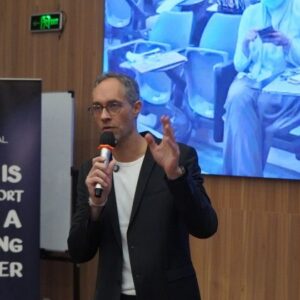
“As an academic and entrepreneur, I see that research, entrepreneurship, and sustainability must be connected, and today this is further strengthened by the use of AI, machine learning, and generative AI in learning and innovation processes,” said Dr. Sahat Hutajulu, S.T., M.M. a lecturer at SBM ITB from the Entrepreneurship and Technology Management Laboratory, while participating in a global forum hosted by The Wharton School, University of Pennsylvania (April 24).
This forum is part of an ongoing effort to strengthen Indonesia’s academic contribution to international discourse on technology and sustainability. This forum is part of the Actionable Knowledge Exchange initiative, which brings together various global stakeholders to discuss the development of artificial intelligence within the context of more inclusive development.
In his presentation, Sahat emphasized that the development of AI presents not only opportunities but also significant challenges, especially for Generation Z. The constantly changing workplace landscape is driving the emergence of increasingly efficient and less structured business models.
In fact, companies can now be built and run without large administrative structures, with operational speeds much faster than before. This requires the younger generation to be more adaptable and prepared to face uncertainty.
“AI not only accelerates development, but also amplifies existing realities. In some contexts, such as in Africa, we see that technology can actually widen inequalities if not accompanied by the right approach,” said Sahat.
He further explained that AI acts as an amplifier, amplifying both opportunities and challenges. Without an inclusive approach, technology can deepen inequalities, especially for groups without access to education, research, and capacity-building. From this perspective, he highlighted the important role of research and education in ensuring that technological developments are not only enjoyed by certain groups but are more equally accessible.
From a policy perspective, Sahat also addressed concerns about the impact of technology on the labor market. The large-scale adoption of AI could trigger significant disruption, including the potential loss of many jobs in a relatively short time.
However, he emphasized that by strengthening education and research, society can adapt and develop new capabilities. The main challenge is ensuring that disadvantaged groups are not left behind in this transformation.
“If we don’t link AI to the SDGs and ESG, many will be left behind. Therefore, capability development and knowledge sharing are crucial, as we see from various research initiatives in developing countries that have contributed to building their countries’ capacities,” he added.
In closing, Sahat emphasized that AI capabilities are not merely a technological concept but an approach that demands a balance between innovation and sustainability. The role of academics is crucial in bridging global discourse with real-world implementation, ensuring that technological transformation has a more inclusive and relevant impact, particularly in the Indonesian context.