Management and business students have significant potential to grow as data analysts due to their strong analytical thinking skills and understanding of business concepts. However, they need to improve their technical skills to meet industry demands.
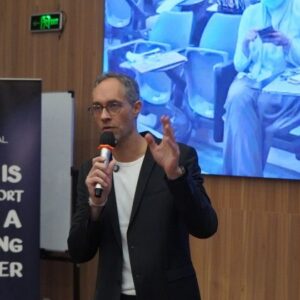
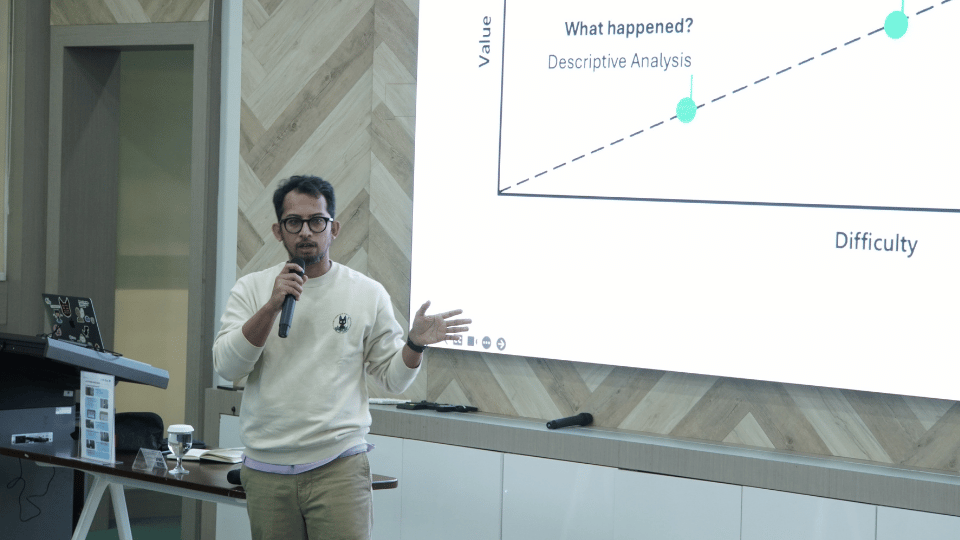
“Business students generally have strong soft skills, but their technical abilities need improvement, particularly because these skills are highly sought after in today’s industry,” said Ilham.Nurdayat, Chief Technology Officer of PT Beesar, a Video Management System (VMS) solutions company, while speaking at a Data Analytics Bootcamp titled “From Raw Data to the Right Business Decisions” at SBM ITB Bandung (June 29).
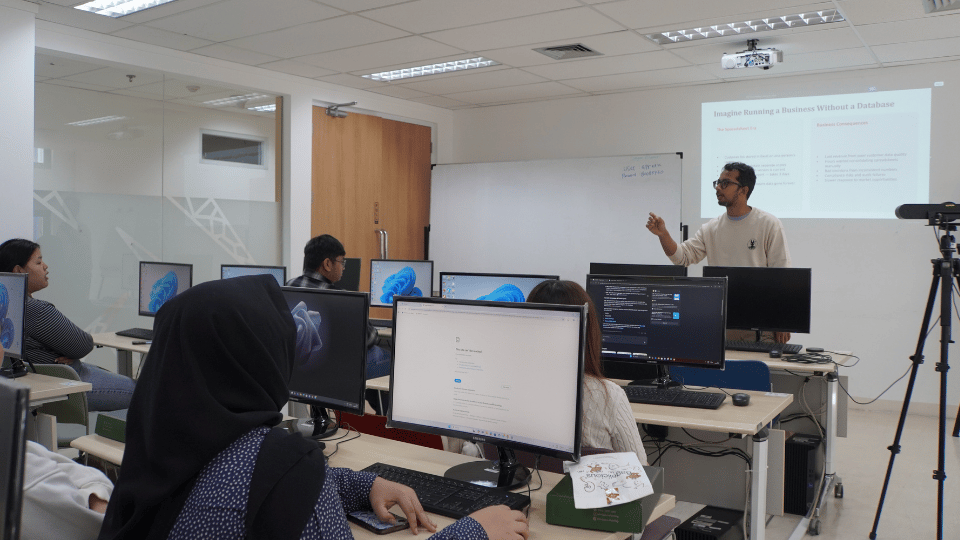
The Management Study Program, in collaboration with the Social Simulation and Big Data Analytics Laboratory of the School of Business and Management, Institut Teknologi Bandung (SBM ITB), held a bootcamp to strengthen students’ understanding of the role of data analytics in industry. Over three days, June 29-July 1, 2026, students were equipped with the skills to understand, process, and apply data analysis to support business decision-making.
This bootcamp is designed to bridge academic understanding with industry needs. Through a “Learn by Context” approach, students not only learn theoretical data analytics concepts but also understand their application in solving real-life business problems from practitioners.
Ilham emphasizes that the data analysis process begins not with examining the data itself, but with understanding the business problem at hand. A crucial step in this process is to ensure that the definitions and objectives of the business are aligned between data analysts and the users of the analysis results.
“The first thing to do is understand the company’s definition of profit and ensure that this definition is agreed upon by dashboard users or those who use the analysis results. We need to align perceptions before looking at the data,” he explained.
He gave an example of how a single business concept can be interpreted differently across divisions. The definition of profit for a marketing team, for example, may differ from that of an operations team. Therefore, data analysts need to understand the business context so that the analysis results truly meet the organization’s needs.
During the bootcamp, students are introduced to four main types of data analytics: descriptive, diagnostic, predictive, and prescriptive. Descriptive analytics is used to understand “what happened,” diagnostic analytics explains “why it happened,” predictive analytics helps predict “what will happen,” while prescriptive analytics provides recommendations on “what should be done.”
Ilham explained that the level of analysis complexity increases from descriptive to prescriptive analytics. Companies, for example, can use predictive analytics to determine when a customer is profitable, and prescriptive analytics to determine strategies to make that customer more valuable.
“The role of an analyst isn’t just to crunch numbers, but to generate insights that can help businesses make better decisions,” Ilham explained.
In addition to understanding analysis concepts, participants learned the workflow of data analytics projects in industry, including business understanding, data acquisition and comprehension, data wrangling and cleaning, modeling, and deployment. Participants were also introduced to structured data, such as tables and databases, as well as unstructured data, such as videos, images, and other complex data formats.
Ilham also emphasized the importance of data interpretation skills. He explained that data does not always directly reflect the entire situation, so analysts need to understand how data is formed and the meaning behind the numbers displayed.
“Data isn’t just about numbers. We need to understand how data is generated and how to interpret it to generate accurate insights,” he added.
On the second and third days, the activity continued with hands-on experience sessions. Students practiced data processing using Python, including the Pandas library, and SQL to manage and retrieve information from databases.
Through these practical sessions, participants not only understood the concept of data analysis but also practiced applying a data-driven approach to solving business problems.