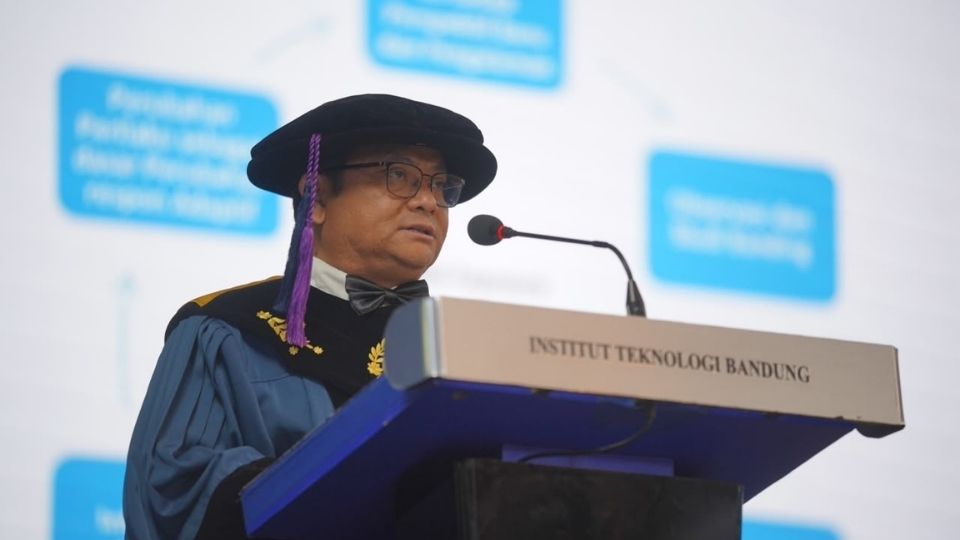
Prof. Henndy Ginting, a lecturer at the School of Business and Management, Institut Teknologi Bandung (SBM ITB), highlighted the shift in the needs of today’s organizations. Today’s organisations need leaders who can face uncertainty and environmental change. Therefore, leader selection and development cannot be based solely on experience but must be directed toward the organisation’s future needs.
According to Henndy, the assessment of prospective leaders at various levels needs to be structured through assessments and fit-and-proper tests to identify the suitability of individual competencies and readiness to meet leadership demands.
“This is what is called the shift from experience-based to future-led development,” said Prof. Henndy in his scientific speech entitled “Modification of Complete Leadership Behavior” in the West Hall of ITB on Saturday (August 8th).
During his time teaching psychology and organizational behavior, Prof. Henndy has extensively studied the development of individual behavior to support organizational needs, particularly leadership. The Chair of the SBM ITB Senate has mentored 20 undergraduate students, 100 master’s students, and 7 doctoral students. He has published 22 international publications as first author or co-author, as well as 19 national publications.
Regarding the shifting needs of leaders, Henndy stated that organizations require more accurate assessments. Assessments should not only look at a person’s experience but also at potential and behaviors that can be developed to meet future organizational needs.
Prof. Henndy then introduced the Behavior Modification of Complete Leadership, a concept that integrates behavioral psychology, leadership theory, and organizational needs. Behavior modification serves as the scientific foundation for leadership development.
Complete leadership involves more than just the ability to manage an organization. Before leading others and an organization, leaders must be able to lead themselves.
“A leader can lead an organization, but they can inspire only if they can lead themselves,” he explained.
This concept encompasses five dimensions. Intrapersonal encompasses self-awareness, integrity, meaning, and purpose. Interpersonal encompasses empathy, communication, collaboration, and relationships. Business and management encompasses strategy, innovation, decision-making, and performance management. Leading the organization encompasses culture building, change management, and organizational empowerment. Global perspective encompasses a global mindset and an understanding of diversity, sustainability, and social responsibility.
Because the characteristics of each dimension differ, their development requires appropriate learning mechanisms. The Leadership Development Journey encompasses community-based, case-based, competency-based, global learning, benchmarking, and project-based coaching. This series builds awareness and motivation, managerial skills, competencies through real-life experiences, cross-cultural insights, new perspectives, and leadership behaviors through projects.
The concept also utilizes the theories of Pavlov, Skinner, and Bandura. Pavlov’s classical conditioning explains learning through stimulus association. Skinner’s operant conditioning explains behavior formation through consequences. Bandura’s social learning theory emphasizes the influence of observation, cognition, and self-regulation.
This synthesis aims to develop future-ready leaders who are adaptive, possess integrity, are globally competitive, and have an impact. Competency-based learning is implemented through a cycle of behavioral practice, observation, feedback, reflection and adaptation, and repetition of practice.
A global perspective is developed through exposure learning in the form of introduction to global issues, case studies, benchmarking, interaction with experts, and dialogue. This process encourages critical thinking, reflection, broadening of thinking frameworks, strategic interpretation, and adaptive behavioral change.
Conceptually, Complete Leadership synthesizes leadership theory and organizational needs. Psychologically, behavior modification serves as its scientific foundation. Pedagogically, the Leadership Development Journey aligns leadership dimensions with learning mechanisms. Methodologically, this approach aligns competencies, learning, and evaluation.
Going forward, the model will be tested through longitudinal, multi-source research across organizational contexts and leadership levels, as well as through learning design to continue evolving through research and organizational practice.