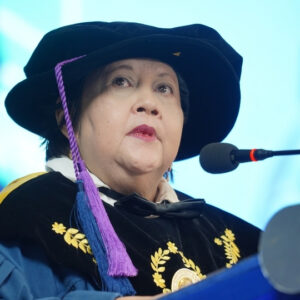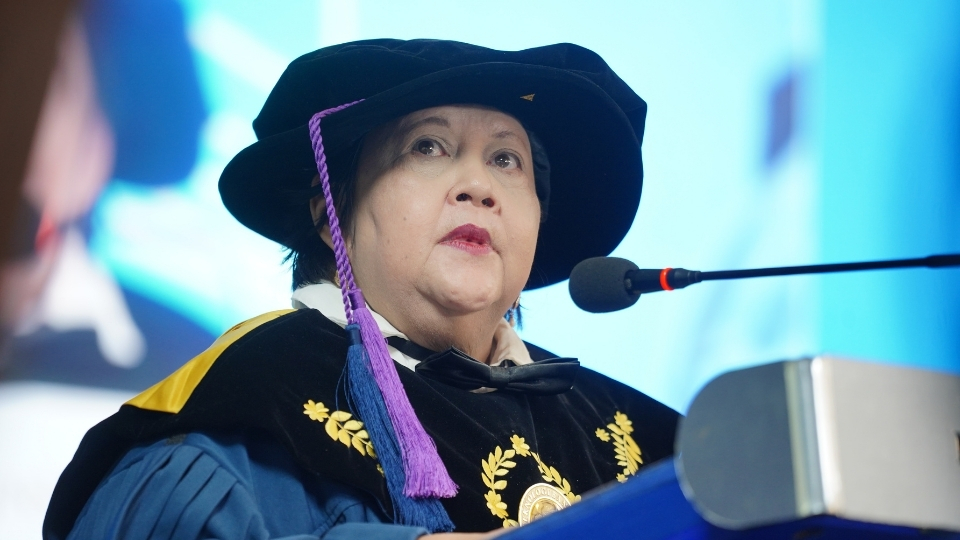
Prof. Mustika Sufiati Purwanegara, a lecturer at the School of Business and Management, Institut Teknologi Bandung (SBM ITB), and a member of the Business Strategy and Marketing (BSM) Research Group, said Indonesia fundamentally has no shortage of knowledge. Universities have lecturers, researchers, and students who produce knowledge, research, and innovation. The government has various policies and development programs. Industry has experience in using technology and creating solutions, while MSMEs possess creativity, local wisdom, and adaptability.
The challenge is how to connect, integrate, and implement this knowledge to achieve greater impact.
“Indonesia has knowledge. The challenge is to connect, integrate, and implement it for greater impact,” he said in a scientific speech entitled “Societal Marketing for Indonesia: Transforming Knowledge into Capabilities and Welfare through Knowledge Orchestration,” held at the West Hall of the Bandung Institute of Technology on Saturday (September 12).
Building on this idea, Prof. Mustika introduced the concept of Knowledge Orchestration, an effort to connect dispersed knowledge, actors, and resources so knowledge can be transformed into capabilities, value, and societal welfare. This process is formulated through the flow of Problem → Learning → Knowledge → Capability → Value.
According to Prof. Mustika, Knowledge Orchestration is not simply knowledge sharing. This concept requires a framework that connects real-world problems with knowledge sources and supporting ecosystems, generating capabilities, added value, and shared prosperity through continuous learning.
This framework is realized through the Knowledge Orchestration Framework (KOF), which has five main stages: Problem Acquisition, Knowledge Orchestration, Capability Development, Knowledge Transformation, and Knowledge Regeneration. These five stages form a cycle that begins with identifying real problems, connecting with relevant knowledge sources and actors, building capabilities, transforming knowledge into solutions and added value, and finally regenerating knowledge through documentation and evaluation of results.
Within this framework, the Knowledge Orchestration System (KOS) serves as a support system that integrates problem and knowledge repositories, collaboration, capacity development, and impact management. The ECOBIZ.ID digital platform supports this system.ID digital platform. Meanwhile, ITB is positioned as one of the national knowledge orchestrators through the implementation of the Tri Dharma Perguruan Tinggi (Three Pillars of Higher Education), encompassing education, research, and community service.
Ultimately, knowledge orchestration is expected not to stop at knowledge production, but to result in increased capability, innovation and productivity; added value and competitiveness; and ultimately, shared prosperity and well-being. This concept positions Societal Marketing not only as an approach to creating value, but also as an effort to connect people, knowledge, collaboration, and a better society to have a broader impact on Indonesia.
Prof. Mustika has contributed to student education and mentoring at SBM ITB since 2008. He has mentored 108 undergraduate students, 242 master’s students, and 10 doctoral students in the Business Strategy and Marketing Research Group at SBM ITB.
Prof. Mustika’s expertise encompasses Consumer Behavior, Neuromarketing, Business Ecosystems, Inclusive Business, and Digital Platform Ecosystems. His recent research includes a neurocognitive study of customer experiences with chatbot service failures across Indonesian and Australian cultures, and the creation of added value from pineapples and their waste through a circular economy approach in Subang Regency.
Since 2019, Prof. Mustika has served as Head of the Neuro Business Laboratory. Mustika was named a World’s Top Researcher in Business and Management by the AD Scientific Index in 2022, received the Community Service Award from the West Java Indonesian Cooperative Council in 2019, and the Best Researcher from SBM ITB in 2017.
Prof. Mustika has published 70 international journal articles, 30 international conference papers, 45 national journal articles, 3 national conference papers, 3 book chapters, and 2 books. This track record demonstrates his consistent contributions to developing knowledge in business and marketing strategy.