As a large and well-known company, Paragon continues to strengthen its operational and production systems in Indonesia to ensure long-term success. More than 16,000 Paragonians, or Paragon employees, across Indonesia and Malaysia support this strategy.
However, according to Juan Jose Caldera Barboza, Paragon’s success depends not only on technology but also on innovation that adds value to its products.
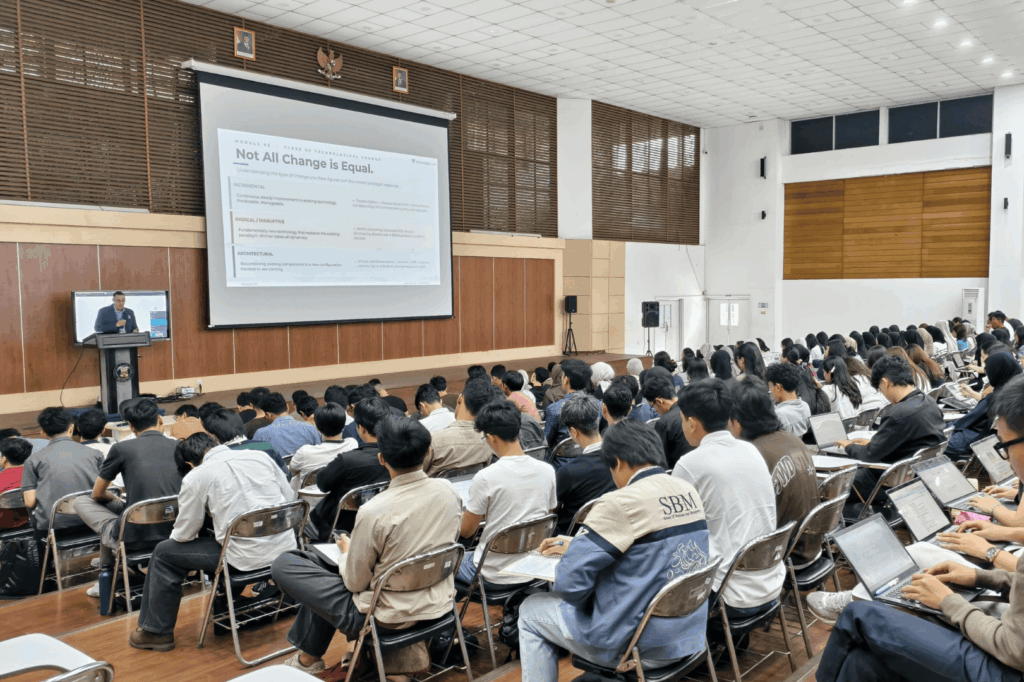
“Technology alone is not the solution. Rather, it is the initial foundation for creating innovation,” Juan said while serving as a guest lecturer at the School of Business and Management, Institut Teknologi Bandung (SBM ITB), on Tuesday (March 31).
Speaking on the theme “Technology, Innovation, and Business Strategy: From Ideas to Competitive Advantage,” Juan explained that innovation, technology implementation, and business strategy are integrated processes within Paragon.
According to Juan, innovation is the process of applying new ideas through technological development. He said innovation does not emerge suddenly; instead, it develops through problem identification, exploration of possible solutions, testing, failure, and adjustment before ultimately resulting in a functional final product.
Juan also emphasized that execution is another equally crucial stage. Even if a product is excellent, poor execution can still lead to failure.
Designing a new product through technological innovation carries significant risks. Companies are often uncertain about whether the technology will succeed and how large the potential market will be.
To address these challenges, Juan outlined four main strategies. The first is “Bet Big” (Pioneer), in which companies make major investments before a technology has proven successful. This approach is suitable for companies willing to take significant risks and seeking to become market leaders. The second strategy is “Fast Follower,” which is suitable for companies that do not want to take high risks, have strong production capabilities, and prefer to learn from the mistakes of pioneers.
The third strategy is “Protect and Extend,” which focuses on maintaining the core business while gradually adapting to new technologies. Juan used Coca-Cola as an example, explaining that the company introduced healthier, sugar-free beverages while continuing to maintain its core products.
The final strategy is “Platform and Ecosystem,” which involves building a system that can be utilized by multiple stakeholders. According to Juan, this approach is useful for creating an ecosystem and increasing the potential to attract a large number of users.
Juan also explained the VRIN framework for determining whether a technology can become a competitive advantage. Through this framework, companies can assess whether a technology provides added value, whether competitors already possess it, how difficult it is to imitate, and whether alternatives exist that could replace it.