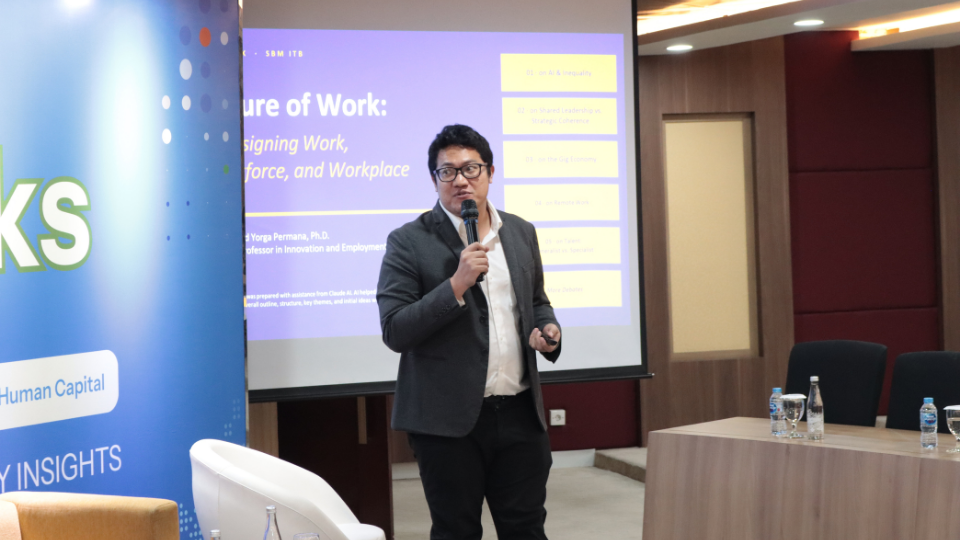
Muhammad Yorga Permana, Assistant Professor in the People & Knowledge Expertise Group at the School of Business and Management, Institute Teknologi Bandung (SBM ITB), stated that the future of work does not have a single definitive answer. The ongoing changes have sparked debates that organizations must understand before shaping their strategies.
One such issue is the development of artificial intelligence (AI). On the one hand, AI can increase productivity and help workers complete work faster. However, the same technology also raises concerns about job losses due to automation.
Yorga posed an important question during his speech at Panel Session 2 of the 6th HCM Talks Series, titled “Future of Work – Redesigning Work, Workforce, and Workplace.” This event was organized by SBM ITB in collaboration with PMSM Indonesia and APRESI at the SBM ITB Jakarta campus (June 9). He questioned whether AI will serve as a productivity equalizer or an amplifier of inequality.
According to Yorga, multiple studies indicate that AI can assist workers with average abilities in boosting their productivity to levels closer to those of top performers. However, there is also a concern that AI could exacerbate inequality, as it tends to benefit capital owners the most, while certain jobs may face the risk of being replaced.
Besides AI, Yorga also highlighted several other debates that will shape the future of organizations. These include the need for more centralized or distributed leadership, the development of the gig economy, the effectiveness of hybrid work models, and the need for generalist and specialist talent.
According to him, there is no completely right or wrong approach. Each organization needs to understand its own context and needs before determining its direction.
“Social science doesn’t tell us what the future will definitely look like. What we can do is understand the various possibilities and choose the path that best suits the organization’s needs,” he explained.
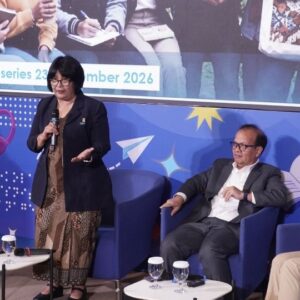
Meanwhile, Agustina Samara, Chief of Human Resources & Corporate Services at PT Asuransi Jiwa Sequis Life and Treasury PMSM Indonesia, encouraged participants to view the future of work from a more human perspective. According to her, the future of work is no longer just about technology or organizational policies, but rather about individual readiness to remain relevant amidst rapid change.
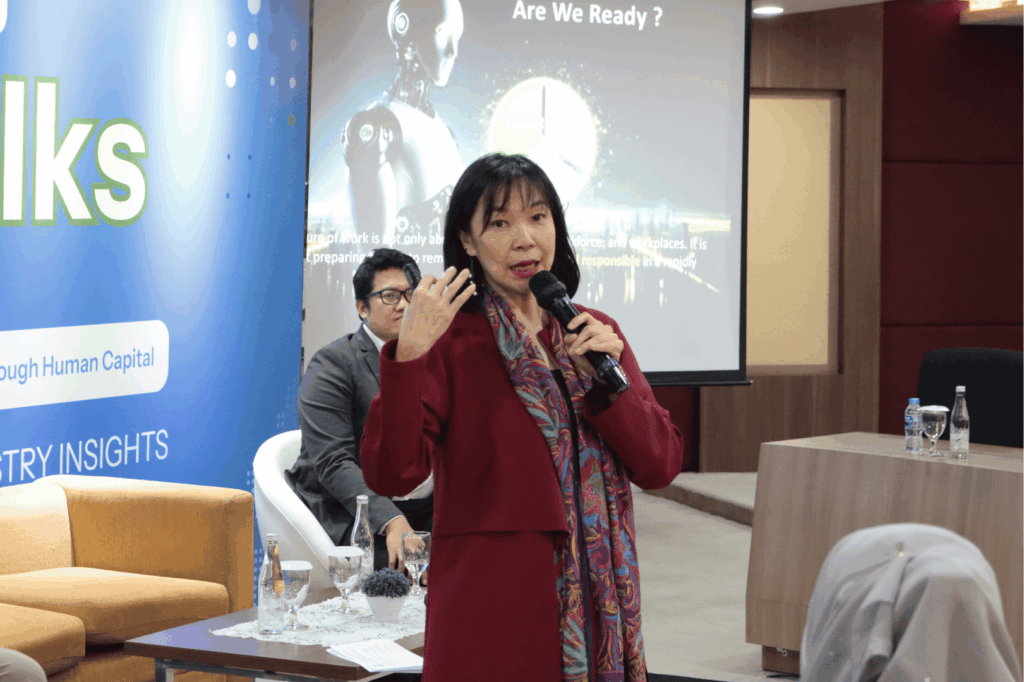
“The future of work is no longer about policy, nor is it about technology. Instead, as human beings, we must have extraordinary relevance and a growth mindset to face these changes,” said Agustina.
Regarding the workplace, Agustina emphasized that organizations need to shift their perspective. She said discussions should no longer focus on work location, but rather on how work can be done effectively.
“It’s no longer about where we work, but how we work,” she emphasized.
According to Agustina, the debate over working from the office and working from home cannot be resolved in a simple, black-and-white manner. While flexible work does present challenges in supervision and collaboration, organizations also need to understand the realities of today’s workforce. Therefore, an effective work system must be supported by a strong organizational culture, performance measurement, and trust.
Regarding the workforce, Agustina highlighted the importance of developing talent amidst uncertainty. She noted that companies cannot guarantee full coverage of future business conditions. Therefore, the skills increasingly needed are not only technical competence, but also the ability to adapt and learn continuously.
Agustina also emphasized the importance of work ethics. Technological advancements, she said, must remain framed by the values of integrity and responsibility. While AI can help people work more effectively and efficiently, it cannot replace individual understanding, creativity, and integrity.
“Some people can create amazing presentations thanks to AI. But when asked to explain the content, they can’t. That’s where we determine whether someone truly understands their job or is simply copying and pasting,” she explained.
Agustina reminded organizations that they need to continue viewing people as assets to be developed, not simply as a workforce that can be replaced by technology. She believes AI should be a tool to help people develop through upskilling and reskilling, not simply a reason to reduce the workforce.
Contributions to the SDGs:
Navigates the future of work amid AI technological disruption by advocating human-centered organizational design, upskilling and reskilling strategies, and equitable talent management policies that bridge productivity growth with workforce resilience.
#SDG8 ##SDG9 #SDG4 #SDG10