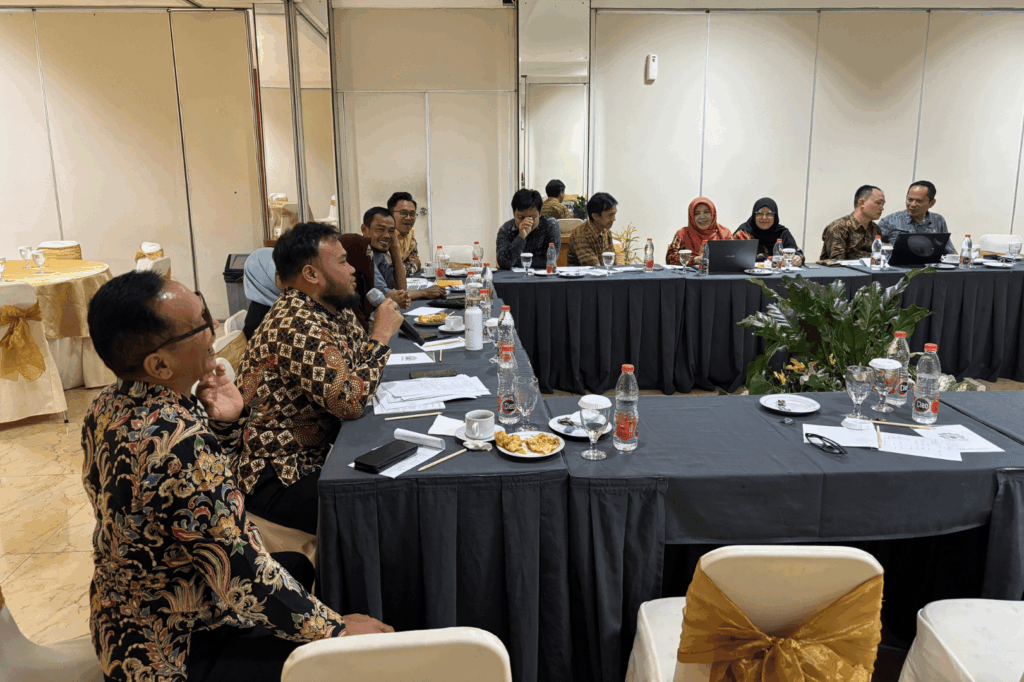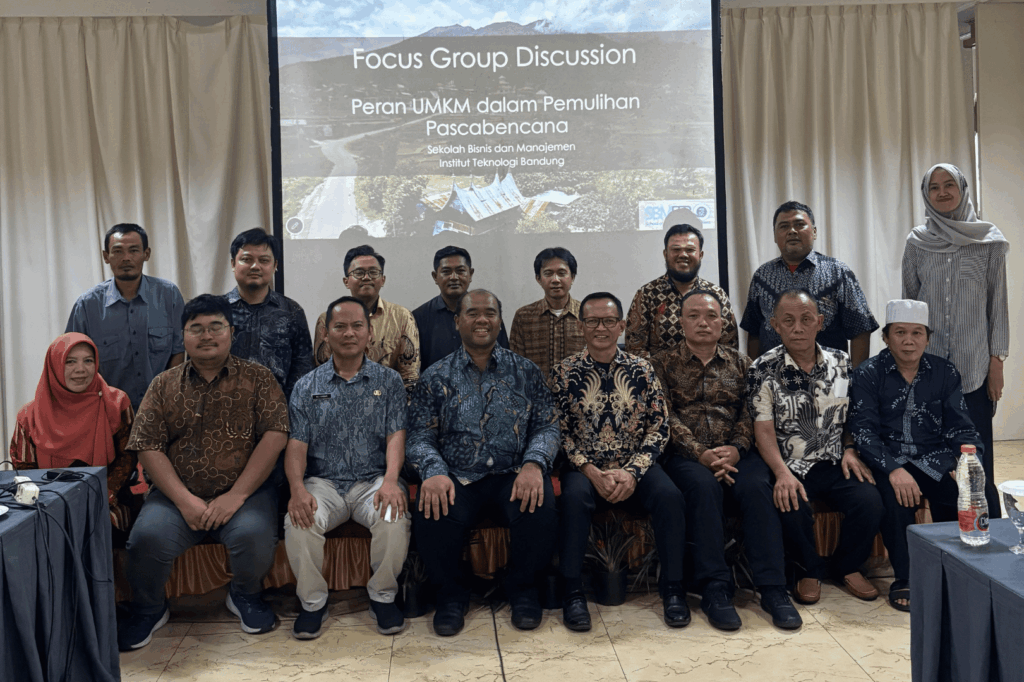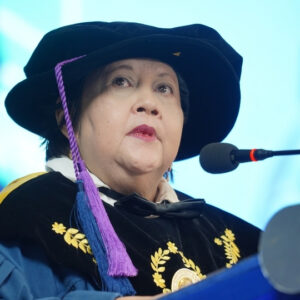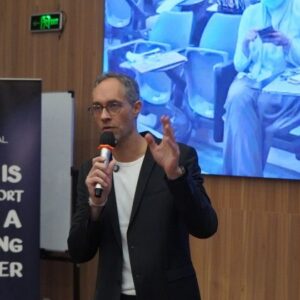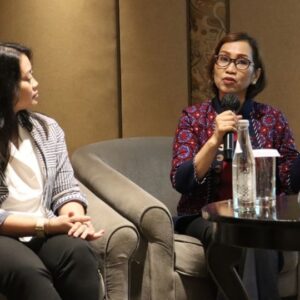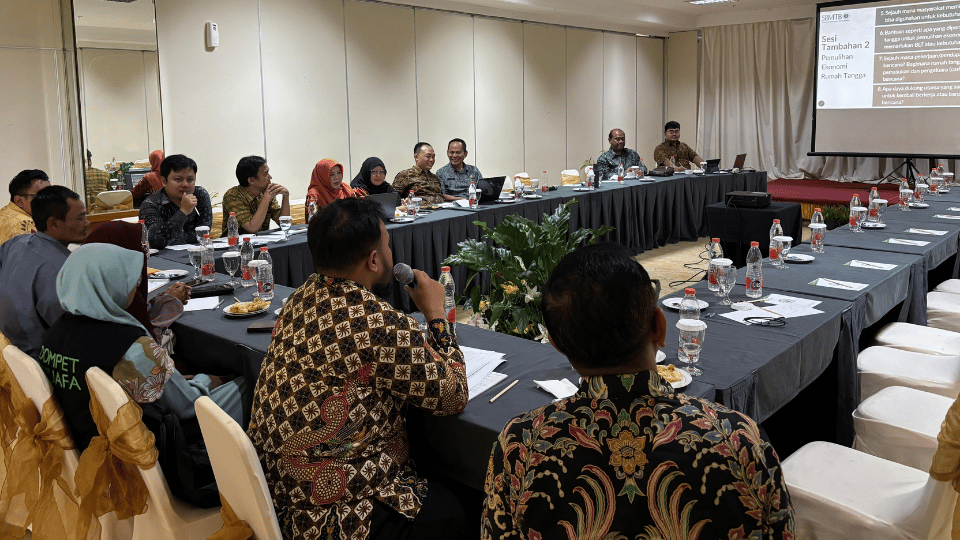
A research team from the Business Risk and Finance Research Group at the School of Business and Management, Institut Teknologi Bandung (SBM ITB), organized a Focus Group Discussion (FGD) on Thursday, 21 May 2026, at Hotel Cianjur, Cipanas, Cianjur Regency, to discuss strategies for post-disaster recovery of micro, small, and medium enterprises (MSMEs) through a more integrated and sustainable approach. The initiative forms part of an ongoing research agenda aimed at generating academic outputs and policy recommendations for regional stakeholders.
The FGD brought together stakeholders representing academia, government institutions, local businesses, and social organizations. Participating institutions included the research team from SBM ITB, the Regional Development Planning, Research and Development Agency (Bappeda/Baperida) of Cianjur Regency, the Office of Cooperatives, MSMEs, Trade and Industry of Cianjur Regency, the Community and Village Empowerment Office (DPMD) of Cianjur Regency, the Cugenang Subdistrict Office, the Government of Sukamulia Village in Cugenang District, representatives of local MSMEs, and social and philanthropic institutions involved in economic recovery efforts, including Dompet Dhuafa and BAZNAS.
The discussion emphasized that Indonesia’s exposure to disaster risks requires recovery strategies that are not only responsive but also adaptive and evidence-based. One of the key objectives of the FGD was to identify and validate variables for developing an Agent-Based Modeling (ABM) framework to better understand MSME recovery dynamics and support more effective policy design.
Participants highlighted that post-disaster challenges extend beyond physical damage and capital shortages. More fundamentally, MSMEs face difficulties in restoring customer bases, rebuilding distribution networks, and regaining market access. These findings suggest that economic recovery requires approaches that go beyond short-term assistance and focus on long-term sustainability.
Taufik Faturrohman, Head of the research team from SBM ITB’s Business Risk and Finance Research Group, emphasized that recovery should be understood beyond immediate assistance.
“Post-disaster MSME recovery is not only about replacing capital or equipment. It is equally important to restore market access, rebuild business networks, and reconnect entrepreneurs with their customers.”
A key topic emerging from the forum was the strategic role of social finance in accelerating economic recovery. Instruments such as Zakat, Infaq, Sadaqah, Waqf (ZISWaf), CSR programs, grants, and philanthropy were considered highly valuable when directed toward productive initiatives supported by needs assessment, mentoring, market strengthening, and sustainability monitoring.
“Social finance can become a strategic instrument for accelerating post-disaster recovery when designed to strengthen long-term economic capacity rather than providing short-term relief alone.”
The forum also underlined the importance of collaboration among government institutions, villages, social organizations, universities, and MSMEs to build a more adaptive, measurable, and data-driven recovery ecosystem.
As a follow-up, the research team will further analyze the findings to support academic publications, develop the ABM framework, and formulate policy recommendations for strengthening regional economic resilience in future disaster contexts.