Sustainable operations strategy is a crucial foundation for organizations in Indonesia to increase efficiency, competitiveness, and adaptability amidst increasingly complex economic, social, and environmental changes.
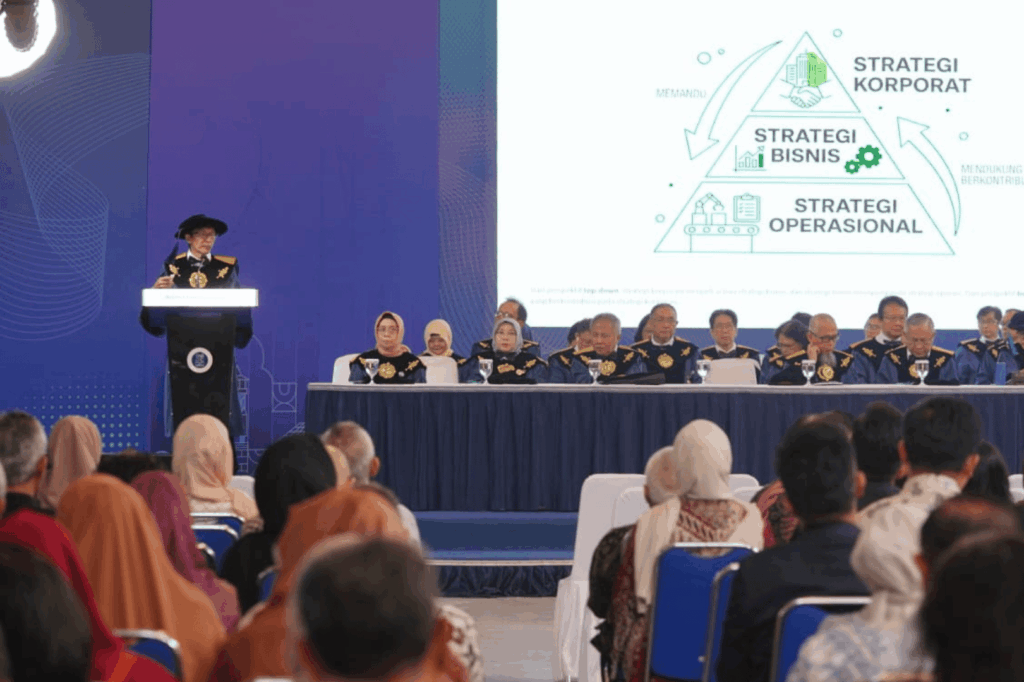
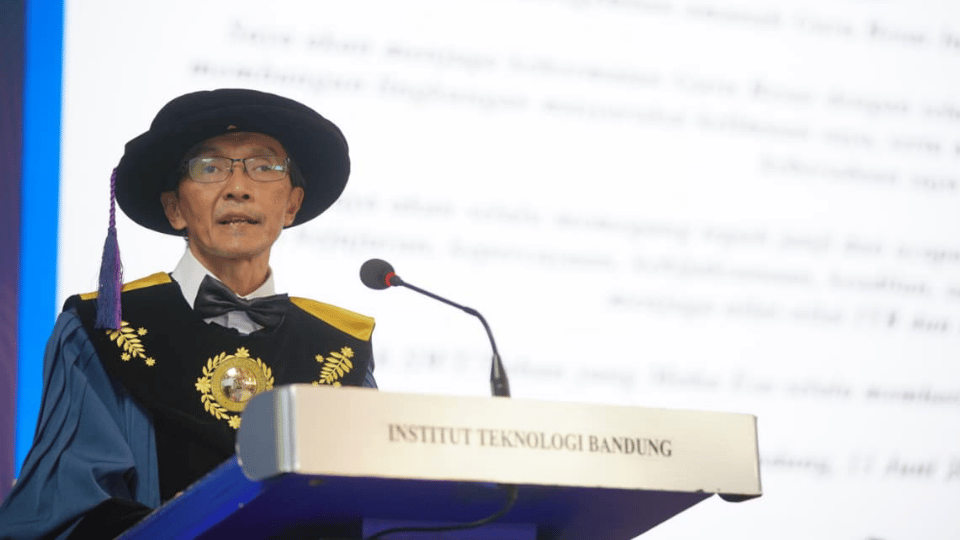
This message was highlighted by Prof. Ir. Gatot Yudoko, M.A.Sc., Ph.D., a lecturer from the Operation & Performance Management (OPM) Research Group at the School of Business and Management, Bandung Institute of Technology (SBM ITB), during his inaugural professorship speech entitled “The Role of Sustainable Operations Strategy in Supporting the Competitiveness of Indonesian Organizations” at the West Hall of ITB, Bandung, Saturday (June 13).
“Operations strategy can contribute to efficiency and productivity, create competitiveness through cost, differentiation, focus, and value innovation, and serve as a means for organizations to adapt and undergo continuous change,” said Prof. Gatot.
According to Gatot, operations strategy does not stand alone. It is part of an organization’s strategic process, which moves dynamically through top-down and bottom-up interactions. A corporate strategy, which embodies the company’s vision, mission, and values, serves as a guide for business and operational strategies. Conversely, practices at the operational level provide feedback on the achievement of organizational goals.
“Corporate strategy will guide business strategy, which then serves as a guide for managers in executing operational strategy. Conversely, from a bottom-up perspective, operational activities will impact the organization’s performance and output,” said Gatot.
In his presentation, Gatot explained that operational strategy encompasses two main groups of decisions. First, structural decisions that determine the physical configuration of the operational system, such as production capacity, facilities, locations, process technology, and supply chains. Second, decisions related to organizational policies, systems, and standards, including human resources, quality, product and service development, performance, operational plans, and organizational structure.
Prof. Gatot also emphasized the importance of the Triple Bottom Line approach, balancing economic, social, and environmental aspects. He believes that the business world needs to play a greater role in achieving the Sustainable Development Goals (SDGs). Indonesia currently ranks 78th out of 167 countries in achieving the SDGs, making the business sector’s contribution increasingly important.
Through multiple case studies, Gatot and his team examined the implementation of sustainable operations strategies in various types of organizations, from large corporations and MSMEs to non-profit organizations and local governments. The study subjects included industrial estates, mining companies, special economic zones, micro and small businesses, food banks, and community-based environmental management programs.
The results showed that the six sustainable operations strategy propositions developed by Gatot and his team were empirically confirmed. Although the level of formality and depth of implementation varied, all organizations studied demonstrated contributions to some or all of the SDGs.
“All the propositions we developed were confirmed by empirical findings, albeit with varying levels of depth and formality depending on the scale and type of organization,” said Gatot.
The study also found differences in contribution patterns across organizations. Large companies generally have more formal, proactive sustainability strategies and are able to contribute to all SDGs. Micro and small businesses focus more on poverty alleviation, job creation, and inequality reduction. Meanwhile, non-profit organizations contribute significantly to issues of food, health, and environmental management.
Based on these findings, Gatot concluded that sustainable operations strategy is not only relevant as an applied theory but also has the potential to develop into a middle-range theory applicable to various scales and types of organizations.
Prof. Gatot is a senior academic at Institute Teknologi Bandung (ITB) with over three decades of experience. He began his career as a lecturer in the Department of Industrial Engineering in 1987 before joining SBM ITB in 2005. As an expert in operations strategy and sustainability, Gatot has published 19 publications in reputable international journals ranked Q1 in Scopus and has a Google Scholar h-index of 21. As of May 2026, he has supervised 54 undergraduate graduates, 259 master’s graduates, and 38 doctoral graduates from various study programs at ITB and other universities.
This scientific oration emphasized the importance of a sustainable operations strategy as a practical framework for Indonesian organizations to build competitiveness that is not only efficient and productive, but also aligned with the sustainable development agenda.