Unlike retail customers, the decision-making process in business-to-business (B2B) sales generally involves multiple stakeholders within the organization, including technical teams, procurement, finance, and company executives. Therefore, the company’s reputation and brand credibility, established through the branding process, are crucial factors in building trust and long-term customer relationships.
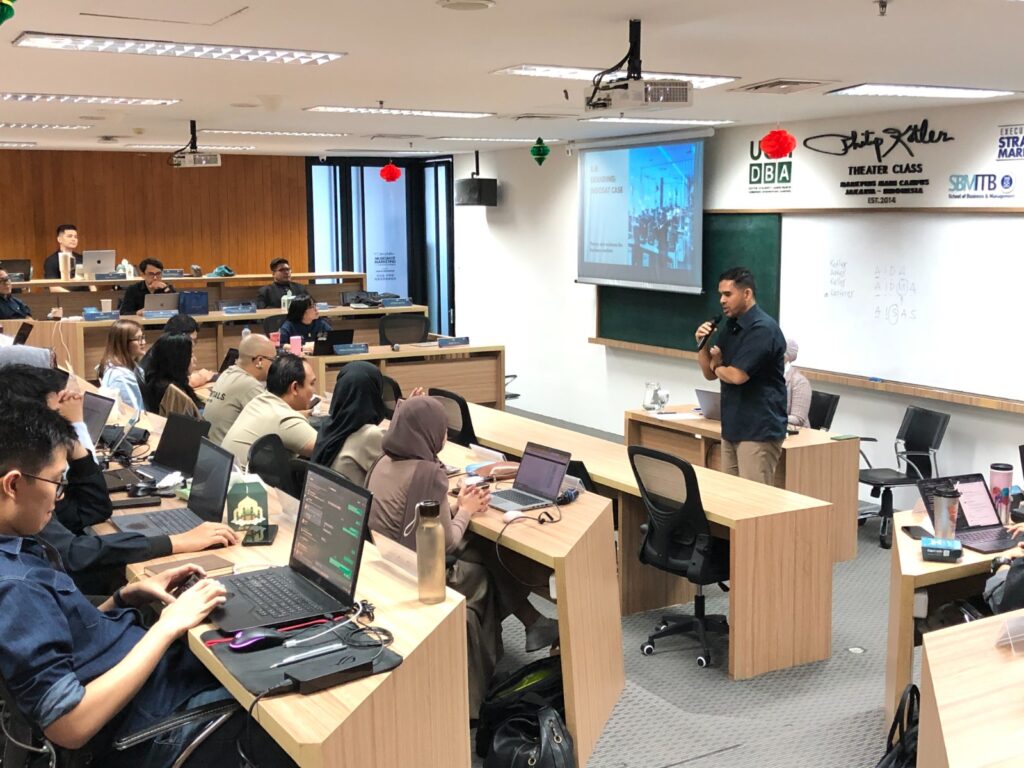
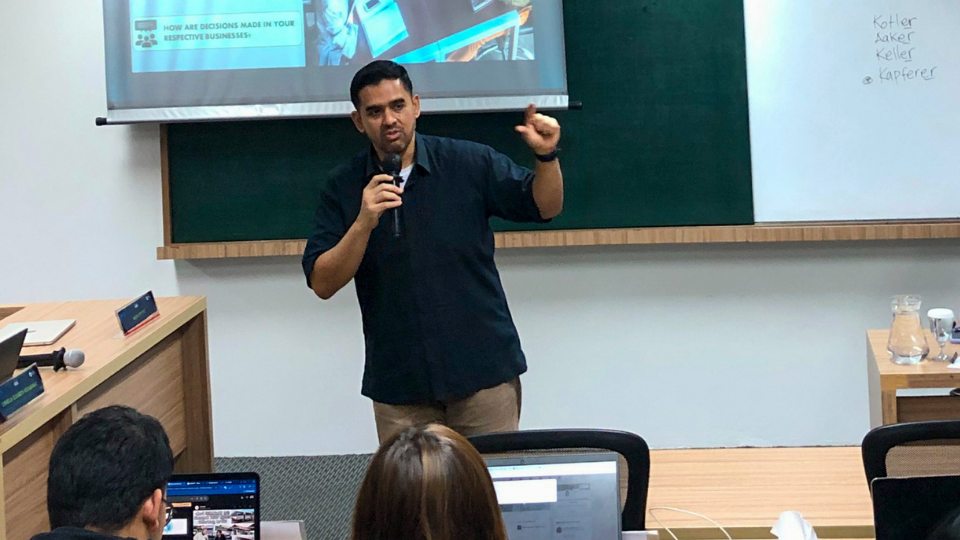
This insight was shared by Muhammad Rafiq, Head of Segment Marketing & Inside Sales at Indosat Business, during a guest lecture on Branding and Marketing Communications for Strategic Marketing Executive MBA Batch 9 (SMEMBA 9) students at School of Business and Management, Institut Teknologi Bandung (SBM ITB), held at the MarkPlus, Inc. office in Jakarta on Sunday (March 15th). Rafiq presented a presentation entitled “B2B Branding: Indosat Case — Theory and Evidence for Business Markets.”
According to Rafiq, in many B2B cases, the company’s brand often represents the overall solution offered, not just individual products or services. This makes a company’s reputation, service track record, and ability to support customer operations crucial elements of a branding strategy.
The concept of B2B branding emphasizes that brands play a crucial role in establishing long-term relationships between companies and their business customers. Branding in the B2B market not only serves as a corporate identity but also influences purchasing decisions, strengthens partnerships, and builds long-term loyalty.
Rafiq argued that the B2B branding system comprises three main components: brand identity, brand positioning, and brand experience. In Indosat’s Business strategy, this B2B branding concept is implemented through various digital transformation initiatives, primarily based on artificial intelligence (AI).
Rafiq explained that Indosat is currently undergoing a strategic repositioning, from being a mere telecommunications service provider to a digital transformation partner for companies. This repositioning requires the company to provide a clear signal to the market regarding its new direction and capabilities.
“Indosat’s business (B2B) customers need more than just a SIM card. Therefore, credible signaling is needed. The brand projects a signal to customers about who we really are,” Rafiq said.
As part of this strategy, Indosat is presenting Indosat Business AI Day, an initiative designed to strengthen the company’s position as a provider of artificial intelligence-based technology solutions for business customers.
“We create credible signaling through activities like AI Day. We want to demonstrate that Indosat is the AI company of choice for business customers,” he explained.
Indosat is also developing various AI-based technology initiatives, including Sahabat AI, a large language model (LLM) service developed in collaboration with Gojek. This technology is designed as a sovereign LLM grounded in the local Indonesian context and is expected to support the development of the national technology ecosystem.
This initiative is part of Indosat’s strategic vision, focusing on three main directions: becoming an AI Telco, an AI Techco, and an AI Nation Shaper. Through this approach, the company not only integrates AI into its network infrastructure and internal systems but also provides various digital solutions for business customers and supports the development of digital talent in Indonesia.
Rafiq also mentioned the communication and marketing strategies of Indosat to maximize the impact of the AI Day initiative. These strategies are designed through three main stages: pre-campaign, in-campaign, and post-campaign.
Through this guest lecture, Strategic Marketing Executive MBA students from SBM ITB gained a more comprehensive perspective on how B2B marketing concepts can be strategically applied in a constantly evolving industry. The presence of industry practitioners like Muhammad Rafiq also provided a concrete picture of how companies develop branding, communication, and technological innovation strategies to maintain competitiveness in the era of digital transformation.