Eligibility: Indonesian nationals
Duration: Full-Time – between three and four years fixed term
Application deadline: 29 April 2026
Interview date: 4 – 8 May 2026
Start date: August 2026
For further details contact: Dr.rer.pol. Eko Agus Prasetio, MBA (Institut Teknologi Bandung) and Prof. Benny Tjahjono (Coventry University)
Introduction
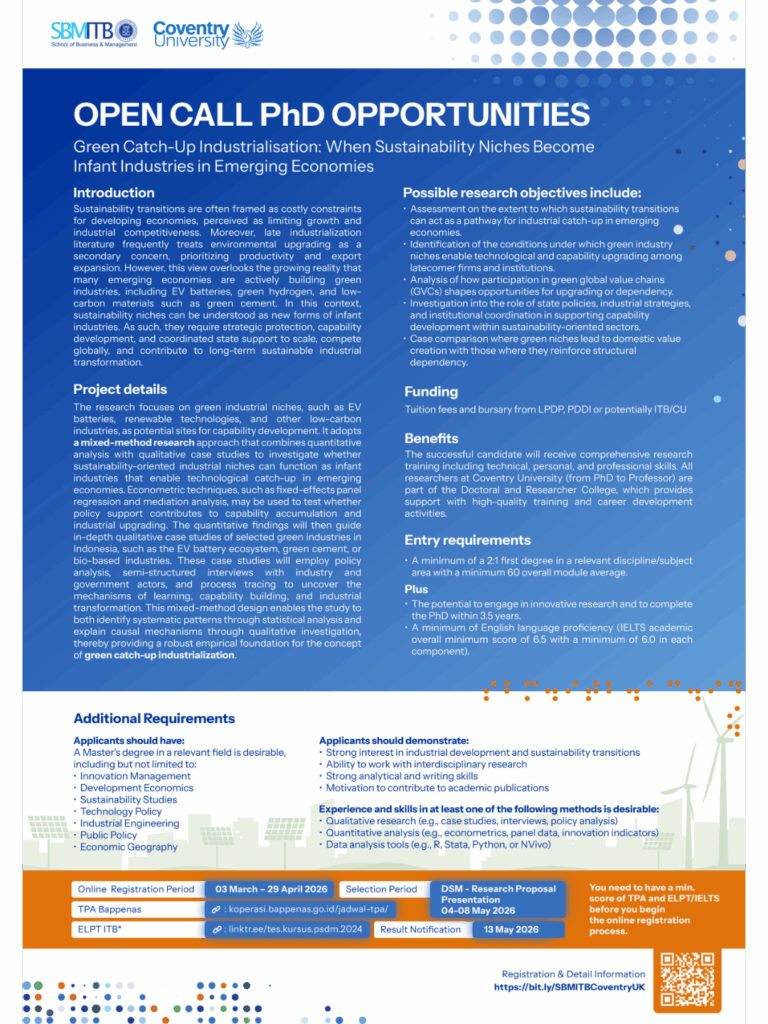
Sustainability transitions are often framed as costly constraints for developing economies, perceived as limiting growth and industrial competitiveness. Moreover, late industrialization literature frequently treats environmental upgrading as a secondary concern, prioritizing productivity and export expansion. However, this view overlooks the growing reality that many emerging economies are actively building green industries, including EV batteries, green hydrogen, and low-carbon materials such as green cement. In this context, sustainability niches can be understood as new forms of infant industries. As such, they require strategic protection, capability development, and coordinated state support to scale, compete globally, and contribute to long-term sustainable industrial transformation.
-
Project details
The research focuses on green industrial niches, such as EV batteries, renewable technologies, and other low-carbon industries, as potential sites for capability development. It adopts a mixed-method research approach that combines quantitative analysis with qualitative case studies to investigate whether sustainability-oriented industrial niches can function as infant industries that enable technological catch-up in emerging economies. Econometric techniques, such as fixed-effects panel regression and mediation analysis, may be used to test whether policy support contributes to capability accumulation and industrial upgrading. The quantitative findings will then guide in-depth qualitative case studies of selected green industries in Indonesia, such as the EV battery ecosystem, green cement, or bio-based industries. These case studies will employ policy analysis, semi-structured interviews with industry and government actors, and process tracing to uncover the mechanisms of learning, capability building, and industrial transformation. This mixed-method design enables the study to both identify systematic patterns through statistical analysis and explain causal mechanisms through qualitative investigation, thereby providing a robust empirical foundation for the concept of green catch-up industrialization.
Possible research objectives include:
- Assessment on the extent to which sustainability transitions can act as a pathway for industrial catch-up in emerging economies.
- Identification of the conditions under which green industry niches enable technological and capability upgrading among latecomer firms and institutions.
- Analysis of how participation in green global value chains (GVCs) shapes opportunities for upgrading or dependency.
- Investigation into the role of state policies, industrial strategies, and institutional coordination in supporting capability development within sustainability-oriented sectors.
- Case comparison where green niches lead to domestic value creation with those where they reinforce structural dependency.
Funding
Tuition fees and bursary from LPDP, PDDI or potentially ITB/CU
Benefits
The successful candidate will receive comprehensive research training including technical, personal, and professional skills. All researchers at Coventry University (from PhD to Professor) are part of the Doctoral and Researcher College, which provides support with high-quality training and career development activities.
Entry requirements
- A minimum of a 2:1 first degree in a relevant discipline/subject area with a minimum 60 overall module average.
PLUS
- The potential to engage in innovative research and to complete the PhD within 3.5 years.
- A minimum of English language proficiency (IELTS academic overall minimum score of 6.5 with a minimum of 6.0 in each component).
Additional Requirements
Applicants should have:
A Master’s degree in a relevant field is desirable, including but not limited to:
- Innovation Management
- Development Economics
- Sustainability Studies
- Technology Policy
- Industrial Engineering
- Public Policy
- Economic Geography
Applicants should demonstrate:
- Strong interest in industrial development and sustainability transitions
- Ability to work with interdisciplinary research
- Strong analytical and writing skills
- Motivation to contribute to academic publications
Experience and skills in at least one of the following methods is desirable:
- Qualitative research (e.g., case studies, interviews, policy analysis)
- Quantitative analysis (e.g., econometrics, panel data, innovation indicators)
- Data analysis tools (e.g., R, Stata, Python, or NVivo)
For more information on the application requirements for ITB, click here and for Coventry University, click here.
Please contact for informal enquiries: Dr.rer.pol. Eko Agus Prasetio, MBA (ITB) or Prof. Benny Tjahjono (Coventry University)