
Decision Making and Strategic Negotiation (DMSN)
Better Decisions for Complex Systems
Every significant transformation begins with a decision.
The Decision Making and Strategic Negotiation (DMSN) Research Group at the School of Business and Management, Institut Teknologi Bandung (SBM ITB), advances research that helps organizations, governments, and society make better decisions in increasingly complex and uncertain environments.
Grounded in Systems Thinking and strengthened through Social Simulation, Decision Science, and Business Analytics, our interdisciplinary research develops scientific knowledge and practical decision-support frameworks that enable more informed, resilient, and sustainable decisions.
By integrating research, education, and collaboration, DMSN contributes to better organizations, better public policies, and a better future.
Why Decision Making Matters
Modern organizations operate within interconnected systems where uncertainty, multiple stakeholders, and rapid change are the norm.
Rather than viewing management through individual functional disciplines, DMSN positions decision making as the integrative capability that connects strategy, operations, finance, marketing, public policy, and organizational transformation.
Our central research question is simple:
How can organizations make better decisions in increasingly complex systems?
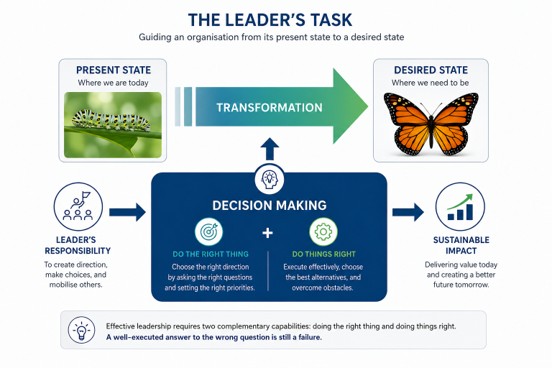
For this reason, DMSN does not approach organisations through traditional functional boundaries such as marketing, finance, operations, or human resource management. Instead, we view decision making as the integrative capability that connects these disciplines and shapes organisational performance as a whole.
Our Philosophy
At DMSN, we believe that better decisions begin with a better understanding of systems.
Our research follows two complementary principles:
Doing the Right Thing
Understanding the system, framing the right problem, and defining meaningful objectives.
Doing Things Right
Evaluating alternatives, selecting appropriate actions, implementing decisions effectively, and adapting to change.
By combining Systems Thinking, Social Simulation, and Decision Science, we help organizations create solutions that are both technically sound and systemically informed.
Body of Knowledge
Our research is built upon Systems Thinking and Systems Science, supported by five interconnected areas of expertise.
01
Decision Making
Developing strategic decision frameworks for complex and uncertain environments.
02
Strategic Negotiation
Creating value through negotiation, stakeholder engagement, conflict management, and collaborative decision making.
03
Social Simulation
Using computational modelling—including agent-based modelling, system dynamics, and discrete-event simulation—to evaluate future scenarios before implementation.
04
Service Science
Designing service ecosystems that improve organizational performance and value co-creation.
05
Business Analytics
Transforming organizational data into actionable intelligence for evidence-based managerial and policy decisions.
Research Philosophy
Our research begins with real-world decision challenges—not disciplinary boundaries.
We combine systems thinking, behavioural science, social simulation, and analytical methods to understand complex organizational systems, evaluate alternative interventions, and translate research into practical solutions.
Rather than viewing research as a one-way transfer of knowledge, we embrace an iterative cycle in which practice informs research and research improves practice.
Research Approach
Complex problems require multiple perspectives.
DMSN integrates:
Quantitative Research
Qualitative Research
Mixed Methods
Hard Systems Methodologies
Soft Systems Methodologies
Systems Thinking
Social Simulation
Behavioural Decision Science
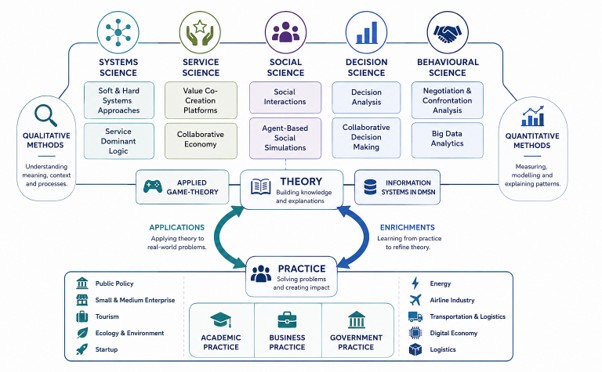
Methodological choices are driven by the nature of the decision problem rather than adherence to a single research paradigm, enabling robust and context-sensitive solutions for complex organizational challenges.
Research Themes
Our research is applied across diverse sectors where strategic decisions shape organizational and societal outcomes. Current research themes include:
Energy Transition
Transportation & Mobility
Public Policy & Governance
Tourism & Destination Systems
Logistics & Supply Chains
Digital Economy
Sustainability & Circular Economy
Financial Systems
Organizational Transformation
Although these domains differ, they share a common challenge: making effective decisions within complex adaptive systems.
From Research to Impact
Our research is designed to create measurable impact beyond academic publications.
We work closely with industry, government, and communities to transform scientific knowledge into:
This commitment ensures that our research remains academically rigorous while delivering practical value to society.
Decision-support frameworks
Executive education
Public policy recommendations
Collaborative research
Organizational transformation
Signature Initiatives
International Forum
DMSN Annual Symposium
An international forum that brings together researchers, industry leaders, policymakers, and students to exchange ideas on decision making, systems thinking, and social simulation through keynote lectures, workshops, doctoral colloquia, and collaborative research sessions.
Since 2019
STEP K–12
The Systems Thinking Education Programme (STEP K–12) introduces systems thinking through experiential, simulation-based learning. Since 2019, the program has reached schools and universities across Indonesia, helping develop critical thinking and collaborative problem-solving skills for future leaders.
Collaborate With Us
DMSN welcomes collaboration with:
Universities and research institutions
Government agencies
Industry partners
International organizations
NGOs and communities
Together, we develop evidence-based solutions that improve organizational performance, strengthen public policy, and create lasting societal impact.